

I know not why there is such a melancholy feeling attached to the remembrance of past happiness, except that we fear that the future can have nothing so bright as the past.
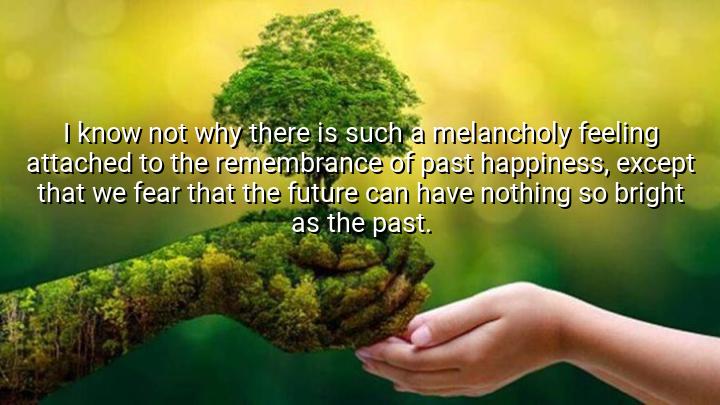




The quote "I know not why there is such a melancholy feeling attached to the remembrance of past happiness, except that we fear that the future can have nothing so bright as the past" by Julia Ward Howe reflects on the bittersweet emotions often tied to remembering happier times. Howe, a poet and social activist, explores the feeling of melancholy that arises when we look back at moments of joy or fulfillment from the past. This sense of sadness is not necessarily because the past was better, but because we worry that the future might not hold experiences as fulfilling or bright as those we’ve already had.
Howe’s words speak to a common human experience: the nostalgia for past happiness, where we idealize former moments and fear that the best of life is already behind us. This longing can cause a sense of loss, as we feel unsure if we can replicate or surpass those joyful times in the years to come. The quote suggests that the fear of the future’s uncertainty and the pressure of expectation may contribute to this melancholic attachment to past memories.
The idea of fearing that the future may lack the same vibrancy as the past taps into a deeper existential concern about meaning and purpose in life. It questions whether we are able to find continued fulfillment, or if we unknowingly set ourselves up for disappointment by comparing future experiences to the ideals of our past. Howe’s reflection on this psychological tendency emphasizes that this fear often stems from our own internalized expectations.
Ultimately, Howe’s quote invites us to confront the paradox of time—the beauty of past happiness paired with the uncertainty of what’s ahead. It reminds us that while the past holds sentimental value, the future can still offer new opportunities for growth and joy, even if it looks different from the experiences we cherish most.

AAdministratorAdministrator
Welcome, honored guests. Please leave a comment, we will respond soon