

I know from personal experience that the abuse of prisoners will produce more bad than good intelligence.
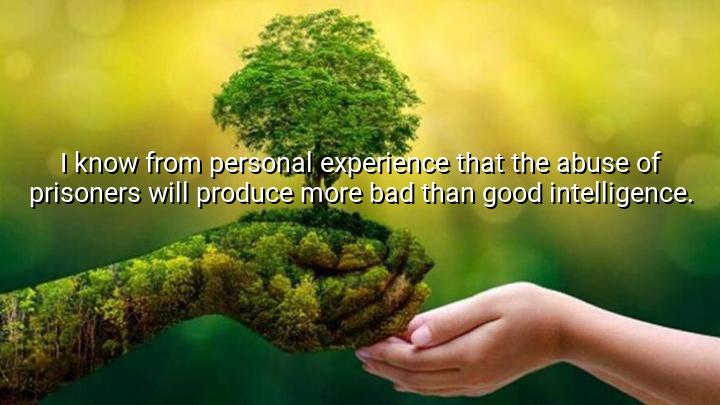




John McCain’s quote speaks to the negative consequences of abusing prisoners in the pursuit of intelligence. Having experienced torture himself as a prisoner of war in Vietnam, McCain emphasizes that such methods not only violate human rights but also undermine the quality of the information gathered. His personal experience with captivity and interrogation gives weight to his claim that the abuse of prisoners, often used to extract information, ultimately leads to inaccurate or misleading intelligence rather than actionable or truthful insights.
McCain’s statement is also a critique of the use of torture as an interrogation tool, especially in the context of national security and the War on Terror. He argues that coercion and violence may yield short-term results but fail in the long run, as prisoners who are abused are likely to provide false information in order to stop the pain. This undermines the trustworthiness of intelligence, which is vital for making informed decisions in matters of national security.
The origin of this quote comes from McCain’s own history as a former U.S. Navy officer and Senator, who was captured and tortured during the Vietnam War. His firsthand experience with torture led him to be an outspoken critic of the use of such methods, both within the military and in broader national security policies. McCain became a key figure in opposing the use of enhanced interrogation techniques, which were widely debated after the events of 9/11.
Ultimately, McCain’s quote serves as a reminder of the moral and practical dangers of using torture in the interrogation of prisoners. It emphasizes that ethical treatment is not only a matter of human rights but also crucial for ensuring the accuracy and reliability of intelligence gathered. By sharing his own experience, McCain reinforces the idea that abuse doesn’t just harm the individual but undermines the very goals it seeks to achieve.

AAdministratorAdministrator
Welcome, honored guests. Please leave a comment, we will respond soon