

I heard the old, old, men say 'all that's beautiful drifts away, like the waters.'
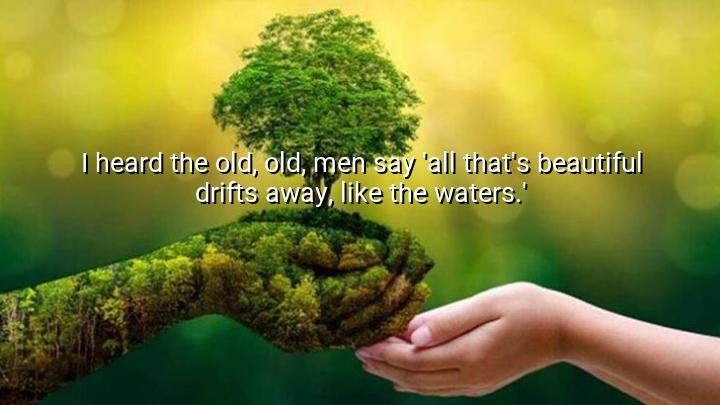




In the quote, "I heard the old, old men say 'all that's beautiful drifts away, like the waters,'" William Butler Yeats captures a haunting meditation on the impermanence of beauty and the inevitability of change. The repetition of “old, old men” evokes a sense of ancient wisdom, suggesting that this observation is not new but rather a timeless truth passed down through generations. Beauty, in this context, is portrayed as something transient, something that slowly drifts away, much like flowing waters that cannot be held or preserved.
The simile “like the waters” deepens the emotional tone, reinforcing the idea that just as water slips through our fingers or moves beyond reach, so too does youth, grace, and all things considered beautiful. Yeats, known for his reflections on aging, loss, and the passage of time, uses this image to explore the melancholy that accompanies the fading of life’s most cherished qualities. It's a poetic reminder of how ephemeral even the most radiant moments and beings can be.
The origin of this quote is from Yeats's poem The Lover Mourns for the Loss of Love, part of his collection The Wind Among the Reeds (1899). In this work, Yeats often merged Irish mythology, romantic yearning, and a sense of spiritual nostalgia, offering reflections that are both personal and universal. This particular line exemplifies his lyrical style and philosophical depth, expressing the human longing to hold onto what cannot last.
Ultimately, Yeats's quote speaks to the unavoidable decay of beauty and the human struggle to come to terms with mortality. It is a gentle yet sorrowful acknowledgment that all things beautiful and beloved are destined to pass, leaving behind only memory—much like the fleeting ripples on water once the current has moved on.

AAdministratorAdministrator
Welcome, honored guests. Please leave a comment, we will respond soon