

I haven't really got a green thumb, but I love gardens and their architecture.
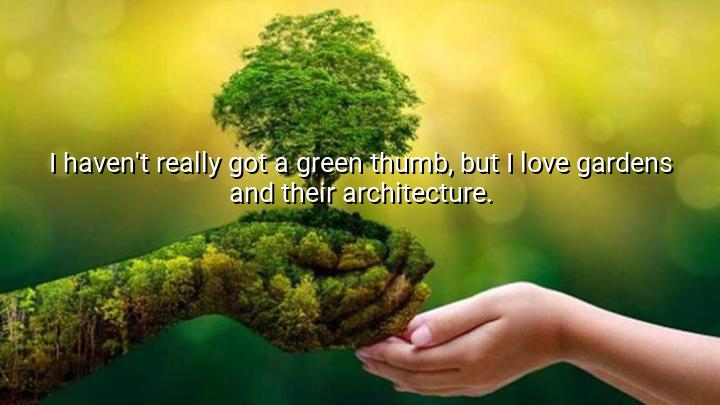




The quote by Hubert de Givenchy — "I haven't really got a green thumb, but I love gardens and their architecture." — reveals a thoughtful appreciation for the design and structure of natural spaces, even if he wasn’t personally skilled in gardening. The phrase green thumb refers to someone with a natural talent for growing plants, and Givenchy humbly admits he lacked that ability. However, his fascination lies not in the cultivation itself, but in the aesthetic and spatial composition of gardens, treating them as carefully designed, almost architectural environments.
By mentioning the architecture of gardens, Givenchy draws attention to how landscape design can be just as intentional, elegant, and refined as building design. This perspective aligns with his background in fashion, where form, proportion, and beauty are paramount. Gardens, in his view, are living artworks — spaces where nature is shaped with artistic discipline to create harmony, serenity, and visual balance. His admiration likely extends to the structured layouts of French formal gardens or the poetic asymmetry of English landscapes, both of which echo architectural thinking.
As a legendary fashion designer, Givenchy was known for his meticulous eye for detail and timeless elegance. His interest in gardens was an extension of his broader love for art, beauty, and design, and he often drew inspiration from such cultivated natural settings. The origin of this quote likely comes from personal interviews or reflections where he spoke about his lifestyle and creative inspirations, particularly from his time spent at his country estate, Le Jonchet, which featured carefully designed gardens.
Ultimately, this quote highlights the intersection of fashion, nature, and architecture in Givenchy’s aesthetic worldview. Even without a hands-on role in gardening, he valued how gardens reflect human creativity, discipline, and emotional resonance — much like his own couture designs. It’s a testament to the idea that appreciation of beauty doesn’t require mastery, only a deep sensitivity to how form and function coexist in the world around us.

AAdministratorAdministrator
Welcome, honored guests. Please leave a comment, we will respond soon