

I grew up in an atmosphere where words were an integral part of culture.
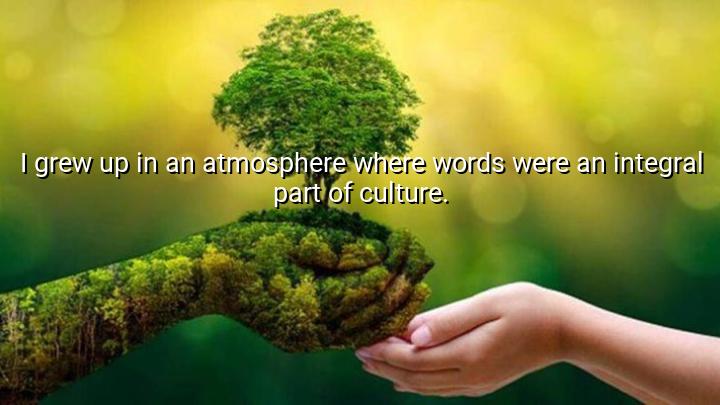




The quote “I grew up in an atmosphere where words were an integral part of culture.” by Wole Soyinka reflects the powerful role that language, storytelling, and oral tradition played in shaping his identity and worldview. Here, Soyinka emphasizes that in his upbringing, words were not merely tools for communication—they were deeply woven into the cultural fabric of daily life. Through poetry, proverbs, rituals, and dialogue, words carried meaning, preserved heritage, and shaped community values.
Wole Soyinka, the Nigerian playwright, poet, and Nobel Laureate, is renowned for his work exploring themes of history, politics, and cultural memory. Growing up in colonial and postcolonial Nigeria, he was deeply influenced by Yoruba traditions and language, as well as Western literary forms. His quote likely refers to the rich literary and oral traditions of his youth, where storytelling and spoken expression were central to understanding the world and one’s place in it.
In saying that words were “an integral part of culture,” Soyinka also draws attention to the idea that language is not separate from cultural experience—it embodies it. Whether through ceremonial chants, folk tales, or political discourse, the spoken and written word served as a vehicle for collective memory, spiritual practice, and resistance. This cultural grounding helped shape his later work, where he masterfully blended traditional forms with modern themes.
Ultimately, Soyinka’s quote honors the profound influence of language-rich environments on intellectual and creative development. It serves as a reminder that literature, speech, and cultural expression are not luxuries—they are essential elements of identity, especially in societies where stories and words carry the legacy of generations. For Soyinka, this immersion in a world of words laid the foundation for a lifetime of artistic exploration and cultural commentary.

AAdministratorAdministrator
Welcome, honored guests. Please leave a comment, we will respond soon