

I don't think of all the misery but of the beauty that still remains.
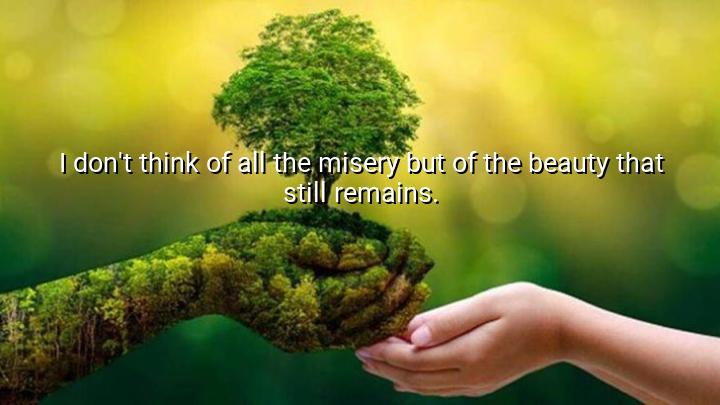




In the quote, "I don't think of all the misery but of the beauty that still remains," Anne Frank expresses a deeply hopeful and resilient perspective amid unimaginable suffering. Rather than focusing solely on the misery surrounding her during the Holocaust, she chooses to turn her attention to the beauty that endures—whether in nature, human kindness, or the possibility of a better future. This quote reflects her inner strength and remarkable optimism, even while living in hiding and facing constant fear.
Frank’s words demonstrate a conscious choice to maintain hope and gratitude despite overwhelming hardship. Her ability to recognize and cherish what still remains—a sliver of sunlight, a flower, or a shared moment of joy—serves as a powerful reminder of the human spirit's resilience. She teaches that even in the darkest times, one can still find light and meaning by focusing on what is good and beautiful.
The origin of this quote is from The Diary of Anne Frank, a firsthand account of a Jewish teenage girl hiding with her family in Amsterdam during World War II. Anne wrote these words while confined in the Secret Annex, reflecting not only her personal strength but also her belief in the inherent goodness of people and the enduring value of life. Her diary, later published posthumously, became one of the most profound testimonies of the Holocaust.
Ultimately, Anne Frank’s quote continues to inspire generations because it offers a lens of hope in adversity. It reminds us that while suffering is part of the human experience, so is the capacity to see and hold onto beauty, even when it is scarce. Her message endures as a call to live with compassion, awareness, and a deep appreciation for the small wonders that give life meaning.

AAdministratorAdministrator
Welcome, honored guests. Please leave a comment, we will respond soon