

I don't separate architecture, design, or culture. What's more important is a language of creativity that carries meaning.
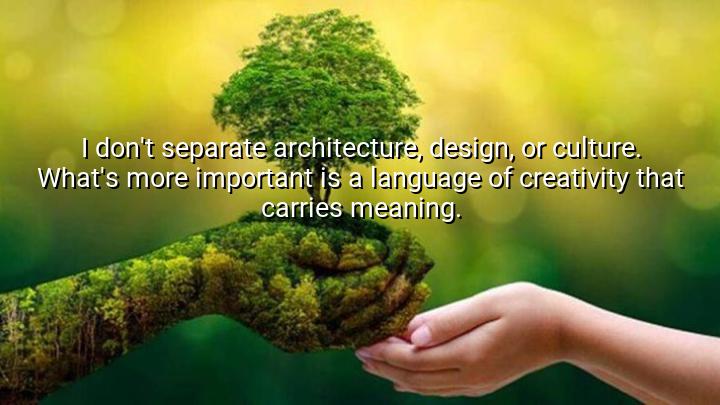




The quote "I don't separate architecture, design, or culture. What's more important is a language of creativity that carries meaning." by Neri Oxman reflects her groundbreaking approach to interdisciplinary design and the fusion of disciplines. Oxman, an architect, designer, and professor at the MIT Media Lab, is known for pioneering work that blends architecture, biology, material science, and technology. In this statement, she challenges traditional boundaries between creative fields, arguing instead for a unified language of creativity that is driven by meaning, not by categories.
By refusing to separate architecture, design, or culture, Oxman emphasizes the interconnectivity of human expression. Each of these domains, while distinct in practice, shares the goal of communicating ideas, shaping environments, and enhancing life. Her focus on a language of creativity points to an underlying structure or logic that transcends disciplines—a way of thinking and making that is organic, expressive, and intentional, grounded in both science and emotion.
This philosophy aligns with Oxman's concept of Material Ecology, a framework where design is informed by nature, and technology becomes a tool for evolution rather than mere utility. Her work seeks to generate forms and systems that carry deep symbolic and functional meaning, much like natural organisms. In this way, creativity becomes not just about aesthetics, but about embedding purpose, context, and intelligence into everything we create.
Originating from her reflections on design innovation in the 21st century, Oxman’s quote speaks to a future where creative practice is fluid, cross-disciplinary, and rich with cultural and ecological significance. It calls for a shift in how we approach design—not as isolated tasks, but as expressions of a shared human story, woven together through a common creative language that speaks to both mind and matter.

YNLe Thi Y Nhi
I appreciate Oxman's holistic view, especially as someone frustrated by the fragmentation in modern creative disciplines. But I also wonder: in striving for such seamless integration, do we risk losing the depth and rigor that each individual field brings? Can architecture maintain its structural discipline, for example, when deeply intertwined with abstract notions of culture and art? Where is the line between integration and dilution?
Lly
I'm intrigued by the idea that creativity has its own language. Does this mean that a building, a chair, or even a digital interface can 'speak' to us on some intuitive level if designed with the right intent? And if so, is it possible to misinterpret that language? I’d love to hear how Oxman ensures clarity and universality in the creative messages she embeds in her work.
KNHoang Le Khanh Nguyen
The statement sounds very idealistic, but how practical is it? In commercial architecture or industrial design, don't budget, regulations, and client demands often force separation between disciplines? I agree that creativity should carry meaning, but what happens when creativity clashes with constraints? Does this integrated philosophy thrive only in elite or niche circles like Oxman's MIT work, or can it be applied broadly in everyday urban development?
SLSan Lu
Is it even possible today to separate design from culture? Every creative act seems to be a cultural expression, whether intentional or not. I wonder if Oxman’s approach is a reaction to overly technical or utilitarian design trends. Is she suggesting a more poetic, holistic method? And if so, how can we as consumers or users of spaces and objects engage with this deeper language of creativity? Do we need to be 'fluent' to appreciate it?
VKPhan Van Khai
This quote really resonates with me, especially in an age where everything is becoming more interconnected. But how do we ensure that this so-called 'language of creativity' isn’t just aesthetically pleasing, but actually meaningful and context-aware? With so much emphasis on visuals and innovation, are we risking depth for spectacle? I’d be curious to know how Oxman defines 'meaning' in design and how she ensures it’s communicated effectively.