

I don't see the desert as barren at all; I see it as full and ripe. It doesn't need to be flattered with rain. It certainly needs rain, but it does with what it has, and creates amazing beauty.
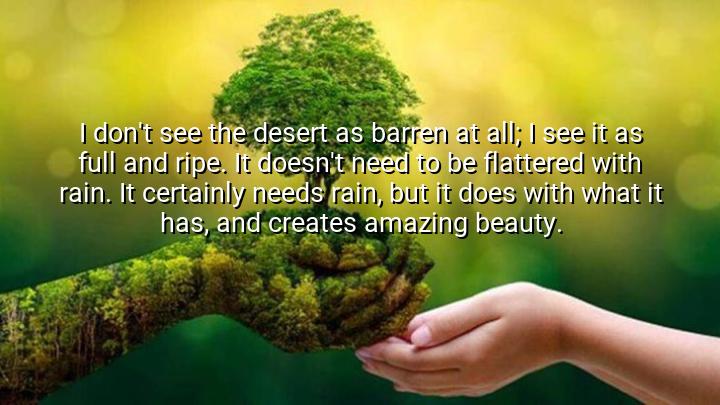




In this quote, Joy Harjo reflects on her perspective of the desert, challenging the common perception of it being barren and lifeless. Instead, she sees the desert as full and ripe, suggesting that even in its seemingly harsh environment, it is rich with life and potential. Harjo emphasizes that the desert doesn't need external flattery, like constant rain, to reveal its inherent beauty. Instead, it thrives and creates something remarkable with the resources it has.
Harjo’s view of the desert aligns with the idea of resilience and adaptation. The desert may face extreme conditions, such as intense heat and limited water, yet it still produces amazing beauty through its unique landscapes, plants, and animals. This reflects the broader concept that even in challenging circumstances, life can still flourish and find ways to thrive and create.
By saying the desert "creates amazing beauty," Harjo underscores the notion that growth and beauty often emerge from places or situations that might initially seem inhospitable or barren. It serves as a metaphor for strength and creativity in adversity, suggesting that life has the ability to adapt, transform, and find beauty even in the toughest of circumstances.
Ultimately, Harjo’s words encourage a perspective shift on what we might consider barren or empty, urging us to look for beauty and possibility in places where others may see only hardship. Her reflection on the desert invites us to embrace the idea that life, in all its forms, can flourish with what it has and create something extraordinary, even in the most unlikely environments.

HGHoang Thi Huong Giang
This quote resonates with me as someone who’s always seen deserts as empty spaces. Harjo’s insight flips that idea—what if we’ve been trained to see lack where there’s actually quiet abundance? I wonder how many personal or societal blind spots this metaphor could apply to. How much of our world do we fail to appreciate simply because we’re not looking closely enough or expecting beauty in a specific form?
CKCuc Kim
There's something deeply spiritual about this view of the desert. It's not just about appreciating a landscape—it's about learning to value what thrives quietly. Do you think our fast-paced society has made it harder to recognize this kind of subtle richness? Maybe we need more moments to stop and realize that not everything has to be loud, green, and flourishing to be alive and meaningful.
TPle tien phuong
This makes me think about how nature reflects human conditions. If the desert can be seen as full and ripe, can the same be said about people who’ve gone through hard times or live without excess? Maybe there's a kind of dignity in making the most of limited resources. I'd be interested in hearing how this idea influences how we treat or judge others who appear to 'lack' something.
NNhan
I find this perspective so refreshing. It made me think about the idea that beauty doesn’t always come from lushness or excess—it can come from survival, from adaptation. Do you think we’ve become too used to associating beauty only with abundance? What might we learn from the desert, metaphorically speaking, about how to create meaning and elegance out of scarcity or limitation?
L626 Nguyen Huu Phat lop 6/4
Joy Harjo’s words feel like a beautiful metaphor for resilience. The desert doesn’t wait for perfect conditions—it thrives in its own way. Do you think this outlook could be a form of mindfulness, seeing beauty and value exactly where we are rather than always craving more? I’m curious how often people pause to appreciate the quiet, subtle abundance around them, especially in a world that pushes constant growth.