

I don't know of any great man who ever had a great son.
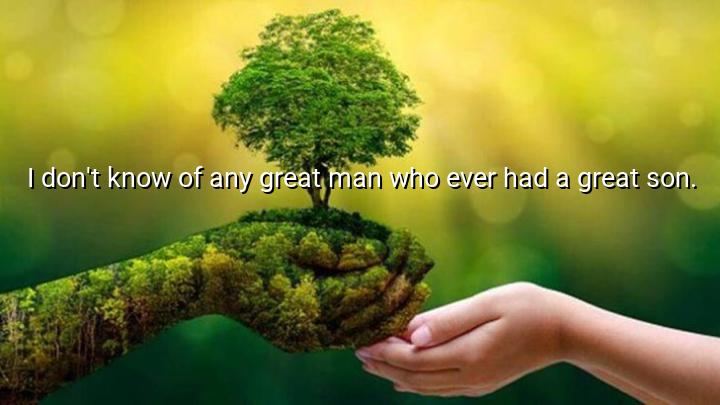




In this quote, Anthony Mann expresses a somewhat cynical view on the relationship between greatness and legacy, particularly focusing on the father-son dynamic. He suggests that the children of great men often fail to live up to their fathers’ achievements. The idea implies that greatness is a rare and difficult trait to inherit, and that the legacy of a great individual may not be fully passed on to the next generation. It highlights a disconnection between the exceptional achievements of a father and the possibility of a child replicating or surpassing those achievements.
Mann’s statement can be interpreted as a commentary on the burden of expectation placed on the children of influential or accomplished people. Being the offspring of a great man might set up unrealistic standards for the son, leading to disappointment or a sense of inadequacy. The quote reflects the idea that greatness is often a result of unique circumstances, individual traits, and the ability to rise above challenges, which may not be easily replicated by a subsequent generation.
The origin of the quote comes from Anthony Mann, an American film director known for his work in the western and historical genres. Mann’s own perspective on the father-son relationship and legacy may have been shaped by personal experiences or his views on individual success. His statement also ties into the broader theme of legacy and how succeeding generations often struggle to carry forward the monumental achievements of their predecessors.
Ultimately, this quote highlights the complexity of legacy and the challenges faced by children who are born into the shadow of greatness. Mann's words serve as a reminder that individual achievement often stems from personal effort and circumstances, and that the expectation for a child to follow in the footsteps of a great man may not always be realistic or fair.

AAdministratorAdministrator
Welcome, honored guests. Please leave a comment, we will respond soon