

I don't have dreams. How can I say it? I myself am a dream.
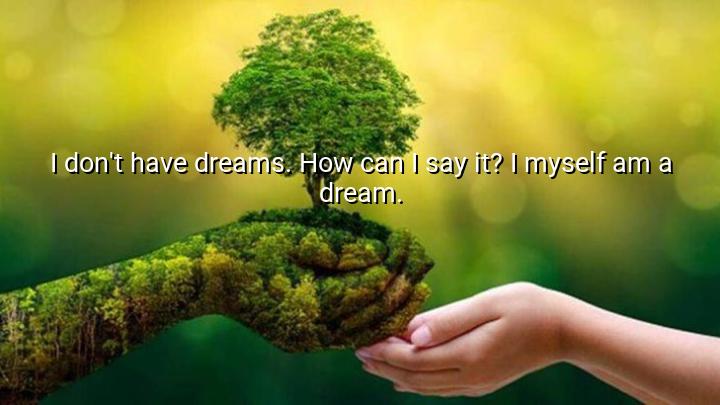




Ayumi Hamasaki’s quote reflects a deep sense of self-empowerment and self-realization. When she says, "I don’t have dreams," she’s expressing the idea that she no longer needs to look outside herself for aspirations or goals. Instead, she sees herself as an embodiment of her own dreams, as if her existence and achievements are the realization of what others might only hope for. The phrase "I myself am a dream" suggests that she has become the living manifestation of the ambitions and visions that she once pursued, indicating a profound transformation in how she views her own identity and purpose.
By describing herself as a dream, Hamasaki implies that she has transcended the conventional idea of pursuing something external. Rather than aspiring to become something or achieve specific goals, she sees herself as the realization of those ideals. This speaks to the empowerment and confidence she has cultivated over time, indicating that her personal journey and achievements have become so integrated into her life that they no longer require external dreams to fuel her.
Hamasaki’s statement also reflects the idea of self-actualization, where an individual’s full potential has been realized. In this sense, she has evolved from dreaming about a future to embodying that future through her very being. It emphasizes the idea that success and purpose are not always something we chase but can be something we become. Her words suggest that the journey itself, and the growth along the way, can be the most powerful dream of all.
Ultimately, Hamasaki’s quote captures the essence of personal evolution and the concept of living as an active participant in one’s own destiny. Rather than waiting for dreams to be realized, she has become the realization of her own vision, offering a profound and inspiring perspective on identity and purpose.

AAdministratorAdministrator
Welcome, honored guests. Please leave a comment, we will respond soon