

I don't feel we did wrong in taking this great country away from them. There were great numbers of people who needed new land, and the Indians were selfishly trying to keep it for themselves.
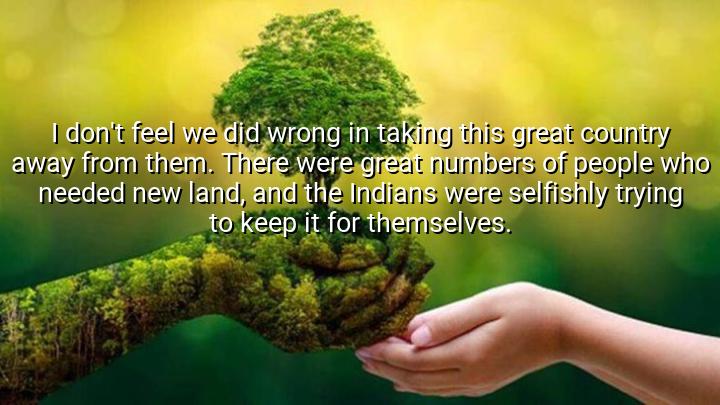




The quote "I don't feel we did wrong in taking this great country away from them. There were great numbers of people who needed new land, and the Indians were selfishly trying to keep it for themselves." by John Wayne reflects a controversial and colonial mindset. Wayne, a famous American actor known for his roles in westerns, is expressing a sentiment that was once common in certain portrayals of American history. The quote reveals a justification for the forced displacement of Native American tribes during westward expansion, commonly known as Manifest Destiny, where settlers believed it was their right to claim the land.
The origin of this quote comes from Wayne's personal views, often shaped by the roles he played in Hollywood, where Western films typically depicted Native Americans as obstacles to the progress of settlers. Wayne, as a product of his time, did not shy away from expressing opinions that mirrored the racist and imperialist ideologies prevalent in the era. His statement reflects the ethnocentric perspective that the Native American way of life was inferior to the expanding white American civilization.
This quote has been widely criticized for its insensitivity and for romanticizing a painful period in American history, where the displacement and near-extermination of Native peoples were justified by the belief that their land was needed for others. Wayne's casual dismissal of the suffering of Native Americans reflects the historical tendency to downplay the consequences of colonization and expansion, focusing instead on the supposed benefits for settlers.
Ultimately, this quote serves as a reminder of the historical and cultural biases that shaped American views during the 20th century. It highlights how Hollywood and figures like John Wayne contributed to the perpetuation of myths surrounding the American frontier, often glossing over the devastating impact of westward expansion on Native American populations. Today, such views are critically examined as part of a larger conversation about the need for acknowledging and reconciling with the country's past injustices.

AAdministratorAdministrator
Welcome, honored guests. Please leave a comment, we will respond soon