

I do not want to go into its physical reasons: the construction of the human body is different from that of carnivorous animals. But man's intelligence is such that it can be utilised to defend any-thing he does, whether right or wrong.
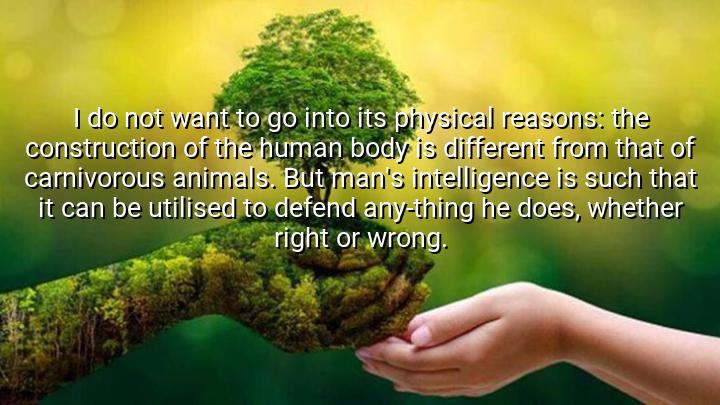




In this quote, Morarji Desai makes a statement about the nature of human intelligence and its ability to justify actions, regardless of their morality. He starts by acknowledging the physical differences between humans and carnivorous animals, hinting that the human body is not designed for the same behaviors as those of predators. However, he quickly shifts focus to human intelligence, which he argues is powerful enough to rationalize or defend any action, whether it is right or wrong. Desai is pointing out the complexity of human reasoning and how intelligence can be used to justify actions, even when they may not align with moral or ethical standards.
Desai’s observation also speaks to the malleability of human thought and how it can be shaped or influenced to support almost any viewpoint. This highlights the subjectivity of human reasoning—while intelligence is often viewed as a tool for making informed and rational decisions, it can also be used to justify actions that may not be ethically sound. This is especially true in contexts where people may have personal interests, cultural norms, or biases that shape their thinking and allow them to defend actions that might otherwise be considered immoral.
The origin of this quote can be tied to Desai’s political and philosophical views. As a former Prime Minister of India, Desai was known for his outspoken opinions on a variety of issues, including governance, ethics, and the role of intelligence in shaping public life. His remarks often touched on the human capacity for self-justification and the moral challenges faced by those in power or positions of influence.
Ultimately, Desai’s words remind us that while intelligence is often seen as a force for good, it can also be used to rationalize actions that may not align with ethical principles. The quote challenges us to be mindful of the ways in which we use our intellect and to consider the moral implications of our decisions, urging a more thoughtful and responsible approach to the power of reasoning.

AAdministratorAdministrator
Welcome, honored guests. Please leave a comment, we will respond soon