

I do not think white America is committed to granting equality to the American Negro. This is a passionately racist country; it will continue to be so in the foreseeable future.
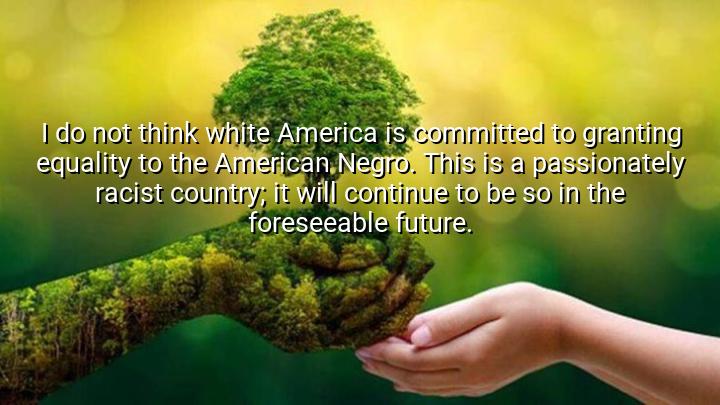




The quote "I do not think white America is committed to granting equality to the American Negro. This is a passionately racist country; it will continue to be so in the foreseeable future" by Susan Sontag reflects her critique of racism and the lack of commitment to true equality in the United States, particularly regarding the treatment of Black Americans. Sontag, a prominent writer and activist, is pointing out that despite the societal progress that has been made, the country remains deeply racist, with systemic inequality still prevalent. She expresses skepticism about the genuine willingness of white America to address the historical and ongoing discrimination faced by Black Americans.
Sontag’s statement underscores the idea that racial equality in America is not merely a matter of legislation or surface-level reforms but requires a profound cultural shift. She argues that racism is not just a problem of individual prejudice but is deeply embedded in the social and political structures of the nation. Her words reflect a realist view of American society, suggesting that the racist attitudes that permeate the culture will not change quickly or easily, making true equality elusive in the foreseeable future.
The origin of this quote lies in Sontag’s broader work as an intellectual and activist who was deeply engaged with issues of social justice and political critique. Throughout her career, she used her platform to speak out on various issues, including human rights, gender equality, and racial justice. Sontag’s insights into the persistence of racism were informed by both her personal experiences and her observations of the social and political climate during her time.
Ultimately, Sontag’s quote is a sharp critique of the structural inequalities in American society and a call to recognize that true racial equality requires more than just superficial changes. It emphasizes the deep entrenchment of racism in American culture and politics and urges a more honest and committed effort to address these issues. By acknowledging the passionate nature of racism in the country, Sontag challenges us to confront the systemic barriers that continue to prevent racial justice.

AAdministratorAdministrator
Welcome, honored guests. Please leave a comment, we will respond soon