

I dare not stay home while Quichuas perish. What if the well-filled church in the homeland needs stirring? They have the Scriptures, Moses, and the prophets, and a whole lot more. Their condemnation is written on their bank books and in the dust on their Bible covers.
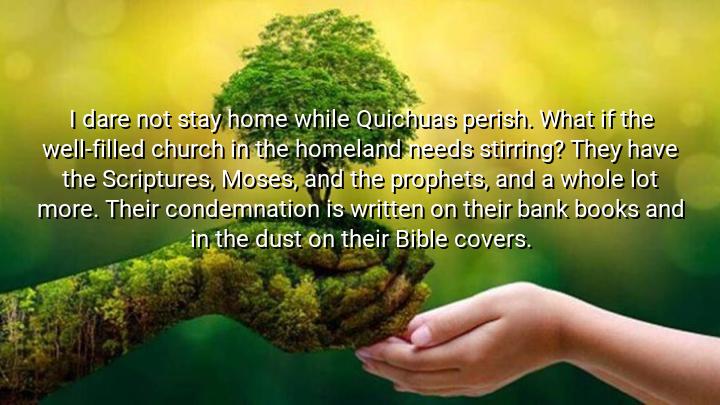




In this quote, Jim Elliot expresses a deep sense of responsibility and urgency to serve those who are suffering, particularly the Quichuas, an indigenous group in South America. Elliot feels a moral obligation not to remain comfortable at home while these people are dying or living in need. His statement reflects his commitment to missionary work, driven by the belief that Christianity must reach those who have not yet heard the message, even at great personal cost. His reference to the well-filled church in the homeland suggests a contrast between those with abundant spiritual resources and those who have little.
Elliot then challenges the idea that the church in more developed countries has everything they need—Scriptures, Moses, and the prophets. He implies that while many have access to religious teachings and spiritual wisdom, they often neglect the true meaning of these teachings in their comfort and material wealth. The line, "Their condemnation is written on their bank books and in the dust on their Bible covers," sharply criticizes those who are complacent in their faith, focusing on material wealth rather than living out the core values of Christianity. Elliot uses this imagery to suggest that spiritual neglect is evident in people's lifestyles and attitudes.
This quote speaks to Elliot's missionary zeal and his belief in the importance of going beyond one's comfort zone to help those in spiritual or physical need. As a Christian missionary who was later martyred for his faith, Elliot felt that the message of the Gospel should be spread to the marginalized and those living in spiritual darkness, regardless of the sacrifices required. His words also serve as a critique of materialism and complacency within more affluent Christian communities, urging them to reflect on their own priorities.
Ultimately, Jim Elliot's quote encapsulates his call to action for Christians to live out their faith actively, reaching out to the lost and living with purpose. It reflects his sense of urgency to bring the message of salvation to the Quichuas and others, while also challenging those who have ample spiritual resources to examine how they are truly living out their beliefs in the context of their own lives.

AAdministratorAdministrator
Welcome, honored guests. Please leave a comment, we will respond soon