

I certainly wasn't happy. Happiness has to do with reason, and only reason earns it. What I was given was the thing you can't earn, and can't keep, and often don't even recognize at the time; I mean joy.
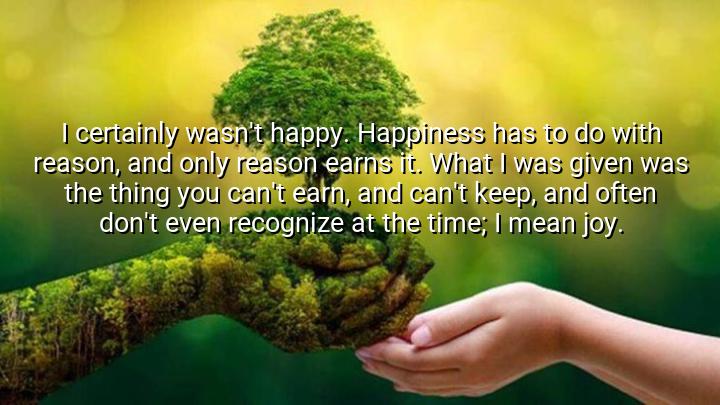




Ursula K. Le Guin’s quote, "I certainly wasn't happy. Happiness has to do with reason, and only reason earns it. What I was given was the thing you can't earn, and can't keep, and often don't even recognize at the time; I mean joy," distinguishes between happiness and joy, two emotions that are often conflated but, according to Le Guin, are fundamentally different. She suggests that happiness is a state tied to logical thinking and reason—something that can be worked toward and earned through rational effort. On the other hand, joy is spontaneous, unexpected, and often not fully recognized or appreciated in the moment.
Le Guin's view of happiness as something earned through reason implies that it is a more structured, goal-oriented feeling, dependent on external circumstances that can be worked toward. In contrast, joy is something more elusive and transient. It cannot be earned or controlled; it arrives unexpectedly and may be fleeting. By stating that joy is "often not even recognized at the time," she reflects on how people may overlook or fail to appreciate moments of joy when they happen, only realizing their significance later.
The distinction between happiness and joy speaks to the larger theme in Le Guin's work of exploring the complexities of human emotions and experiences. She often delved into the unpredictable nature of life and the importance of embracing moments of deep, unearned joy, which can be more profound and transformative than the more stable but rational pursuit of happiness.
The origin of this quote likely comes from Le Guin’s deep philosophical and literary reflections on the human condition. Known for her works of science fiction and fantasy, Le Guin explored the nuances of life, identity, and emotions, frequently offering insights that challenge conventional thinking. This quote encapsulates her belief in the intangible and unpredictable nature of joy, a theme that resonates throughout her writing.

AAdministratorAdministrator
Welcome, honored guests. Please leave a comment, we will respond soon