

I attended classes and taught classes, in Food Anthropology at Pace University, with an anthropology professor. You can trace history by the architecture and food of a place. Food is one of those things that transcends and stays in the culture.
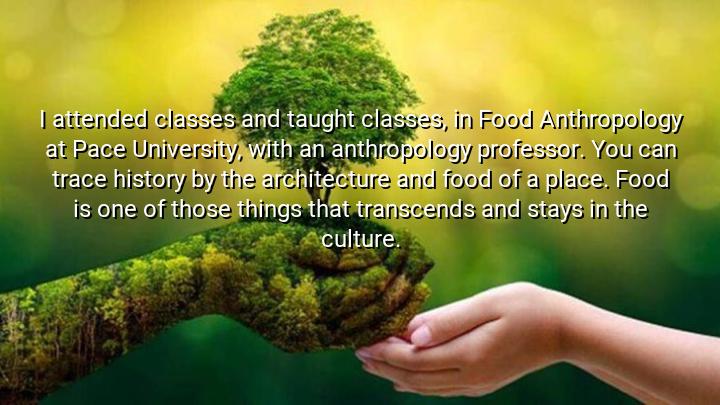




The quote by Lidia Bastianich — "I attended classes and taught classes, in Food Anthropology at Pace University, with an anthropology professor. You can trace history by the architecture and food of a place. Food is one of those things that transcends and stays in the culture." — reflects her deep understanding of the connection between culinary traditions, cultural identity, and historical continuity. As a celebrated chef, author, and television personality, Bastianich emphasizes that food is more than sustenance—it is a living archive of civilization and heritage that reveals the story of a people and their environment over time.
By studying and teaching Food Anthropology, Bastianich explored how cuisine intersects with history, migration, rituals, and architecture. Just as the buildings of a city reveal its historical layers—Roman ruins beneath Renaissance facades, or colonial structures beside modern towers—so too does food reveal the blending and evolution of cultural influences. Recipes, ingredients, and cooking techniques often survive generations, even when languages or borders change, making food a powerful symbol of cultural resilience.
Her reference to architecture and food as markers of history highlights how these two elements are among the most enduring and tangible artifacts of a society. While political regimes may fall and economies shift, the ways people build their homes and prepare their meals often preserve a deeper emotional and communal legacy. Food, in particular, becomes a tool of storytelling, passed down in families and celebrated in rituals, embodying both individual memory and collective identity.
The origin of this quote comes from Bastianich’s involvement in academia alongside her culinary career, particularly her engagement with anthropological studies that focus on the human aspects of food. Through both scholarly and practical lenses, she reinforces the idea that cuisine is not just art or commerce—it is a living expression of culture, capable of bridging generations, geographies, and experiences. Her insights invite us to value the historical and emotional depth that food brings to our understanding of who we are.

AAdministratorAdministrator
Welcome, honored guests. Please leave a comment, we will respond soon