

I asked long ago,'What must I do to be saved?' The Scripture answered, 'Keep the commandments, believe, hope, love.' I was early warned against laying, as the Papists do, too much stress on outward works, or on a faith without works, which as it does not include, so it will never lead to true hope or charity.
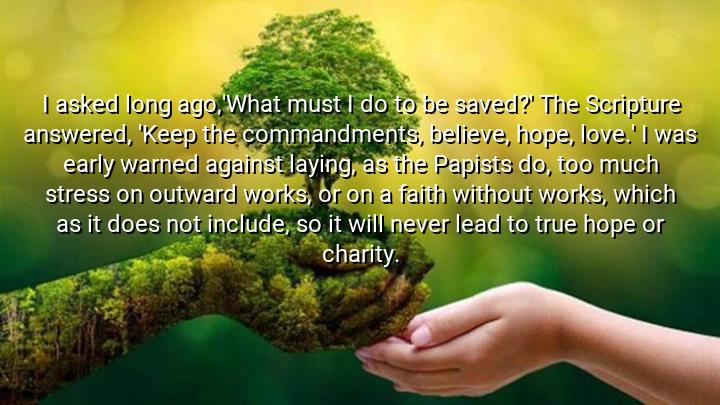




The quote "I asked long ago, 'What must I do to be saved?' The Scripture answered, 'Keep the commandments, believe, hope, love.' I was early warned against laying, as the Papists do, too much stress on outward works, or on a faith without works, which as it does not include, so it will never lead to true hope or charity." by John Wesley reflects a deep understanding of Christian salvation and the balance between faith and works. Wesley highlights the essential Christian virtues: keeping the commandments, faith, hope, and love, all of which are integral to spiritual salvation. He emphasizes that salvation is not just about external rituals or faith alone but involves a holistic practice of living out one's beliefs through actions.
Wesley warns against two extremes: putting too much emphasis on outward works (rituals or external religious practices) without genuine faith, or relying solely on faith without demonstrating it through good works. He critiques what he refers to as the approach of the “Papists” (a term Wesley used for Roman Catholics) for focusing too much on external observances. His point is that true Christian faith must be active, producing hope and charity (love), which cannot exist without both faith and works working together.
John Wesley, the founder of the Methodist movement in the 18th century, was a strong advocate for a balanced Christian life combining faith and practical holiness. This quote reflects his theological stance that true salvation involves both belief and ethical living, emphasizing personal responsibility alongside divine grace. His teachings aimed to encourage a faith that was not only heartfelt but visibly expressed through loving actions.
In summary, Wesley’s quote serves as a reminder that salvation in the Christian tradition requires a harmonious blend of faith, hope, love, and works. It challenges believers to avoid superficial religiosity or passive belief and instead cultivate a faith that actively produces love and good deeds, leading to a fuller spiritual life.

AAdministratorAdministrator
Welcome, honored guests. Please leave a comment, we will respond soon