

Human life moves only in one direction - toward disease, damage, and death. The best you can hope for is to remain stagnant or, in certain cases, return to a previous condition when things weren't as bad as they've become for you.
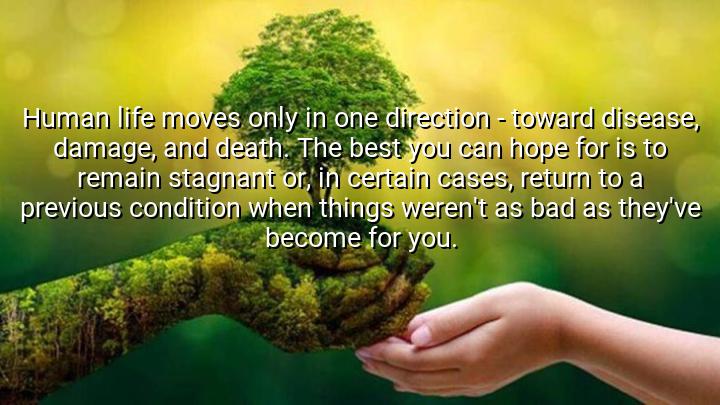




The quote by Thomas Ligotti, an American author known for his work in the horror and philosophical fiction genres, presents a bleak view of human life. Ligotti suggests that life is a continuous march in one direction—toward disease, damage, and ultimately death. This statement reflects a pessimistic and nihilistic outlook on existence, implying that suffering and decline are inevitable, and the best one can hope for is simply to remain stagnant or, in rare cases, revert to a time when things were not as dire. It suggests that progress is an illusion and that life is, in many ways, a process of constant deterioration.
Ligotti’s view challenges the common societal narrative that growth and improvement are inherent parts of the human experience. Instead, he highlights the inevitability of decline, both physical and existential, as a core aspect of life. The idea that the most one can hope for is to either maintain a sense of stasis or regress to a better past speaks to the hopelessness Ligotti sees in human existence, where forward momentum is not a given but something that is more often associated with worsening conditions.
The origin of this quote can be understood within the context of Ligotti's broader body of work, which often delves into themes of existential despair, meaninglessness, and the absurdity of life. In works like Songs of a Dead Dreamer and The Last Feast of Harlequin, Ligotti explores the dark and often terrifying aspects of existence, focusing on the fragility and futility of human efforts to find meaning in a world that seems indifferent to our suffering. This quote encapsulates the essence of his philosophical stance, rooted in a pessimistic worldview.
In essence, Ligotti’s quote serves as a reflection on the inevitable decline of the human condition and the limitations of human existence. It presents a realistic, though grim, perspective on life, urging us to confront the harsh realities of disease, aging, and death, and suggesting that the best one can hope for is either to hold steady or retreat to an earlier, less painful time.

AAdministratorAdministrator
Welcome, honored guests. Please leave a comment, we will respond soon