

Human beings exercise responsibilities within a social setting and a framework of obligations which transcend the principle of intelligence.
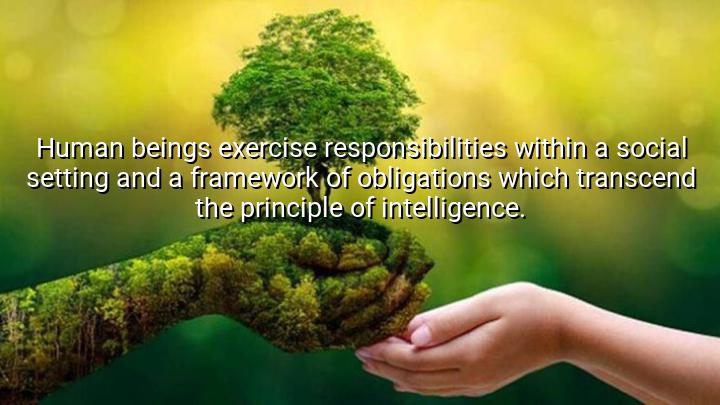




Michael Polanyi’s quote, "Human beings exercise responsibilities within a social setting and a framework of obligations which transcend the principle of intelligence," emphasizes the importance of human action and behavior beyond just rational thought or intelligence. Polanyi is suggesting that while intelligence plays a role in decision-making, responsibilities and ethical actions are often shaped by social context and a deeper sense of duty. These responsibilities, which include moral obligations, cannot be fully understood or guided by intelligence alone, but also by social norms, values, and relationships.
The quote highlights the distinction between cognitive abilities and the moral or social dimensions of human life. Polanyi implies that there are aspects of human life, such as responsibility and obligation, that require more than just logical reasoning or intellectual capacity. They require an understanding of our interconnectedness with others and our place within a larger social framework, where our actions have consequences that extend beyond individual intelligence.
Polanyi’s statement also suggests that intelligence should not be seen in isolation from society and its ethical structures. While intelligence can help individuals navigate complex situations, it is the social setting and the moral obligations imposed by society that ultimately guide responsible action. This speaks to the broader philosophical view that human existence is not just about individual reasoning, but also about cooperation, ethics, and our role in the collective good.
The origin of the quote comes from Michael Polanyi, a Hungarian-British philosopher and scientist known for his work on the philosophy of science and the concept of tacit knowledge. Polanyi’s views on responsibility and intelligence reflect his broader philosophical interest in how knowledge is applied in the social context and how human beings interact within complex social systems. His work often emphasized the limitations of intellect alone in understanding the full range of human experience and action.

AAdministratorAdministrator
Welcome, honored guests. Please leave a comment, we will respond soon