

How can you sing of amazing grace and all God's wonders without using your hands?
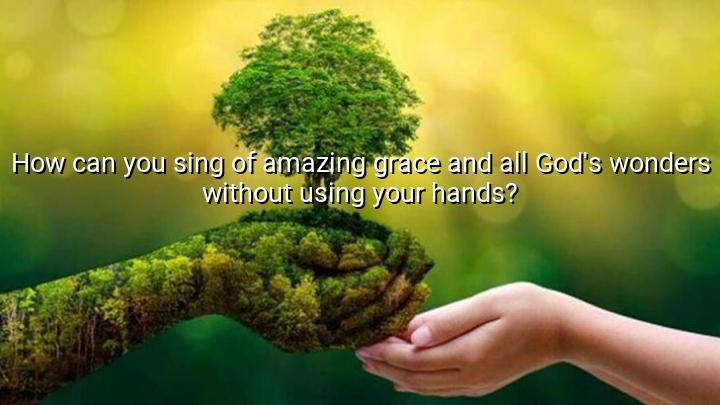




The quote "How can you sing of amazing grace and all God's wonders without using your hands?" by Mahalia Jackson speaks to the profound connection between music, spirituality, and the physical expression of faith. Jackson, known for her powerful gospel music, suggests that truly conveying the depth of religious songs like "amazing grace" requires more than just vocal talent; it demands an embodied experience. Her question challenges the notion of singing without full engagement, implying that the soul's expression should extend beyond words to the whole body, including hands.
In this context, "amazing grace" refers to the well-known Christian hymn that speaks of divine forgiveness and salvation. By questioning how one can sing about God's wonders without using their hands, Jackson is emphasizing the idea that music, especially gospel music, is not merely an auditory experience but a physical and emotional one as well. The act of using one's hands—whether through clapping, gesturing, or simply engaging in the rhythm of the music—is seen as a vital part of the worship and praise process.
Jackson's quote reflects the deeply expressive nature of gospel music, where every part of the body is often involved in the performance. In gospel traditions, the hands are instrumental in channeling the emotion and reverence that come with singing about the grace and miracles of God. By raising this question, Jackson encourages the audience to recognize that true worship and spiritual expression come from a holistic experience, engaging both the voice and the body.
As one of the most influential gospel singers in history, Mahalia Jackson’s words reflect her belief in the power of music to connect people with the divine. The quote embodies her view that gospel singing is a full-body experience, not just an intellectual or vocal exercise, but one that calls for all of a person’s being to be immersed in the worship of God’s wonders.

KDZ Khanh Duong
I’m intrigued by the challenge implied here—can profound emotions truly be conveyed without physical movement? How do singers or speakers who are less expressive physically still manage to move their audience? Does this suggest that emotional authenticity requires visible, tangible actions, or can the voice alone suffice? It’s a fascinating tension between external expression and inner feeling.
HPHa Phuc
This quote prompts me to think about the power of the human body in artistic and religious contexts. How much does the use of hands and gestures influence the impact of a song or prayer? Is it a universal language that transcends words, helping listeners feel the message more viscerally? I’d be interested to know how different faith communities view physical expression in worship.
GLGiang Le
Reading this, I feel a sense of reverence for how deeply embodied spiritual practice can be. How important is it for performers and worshippers to use gestures to communicate their sincerity and passion? Could the absence of such expression make a performance feel less genuine, or might it simply reflect different personal styles? It raises questions about the role of nonverbal communication in emotional and spiritual experiences.
QQuynh_2311
I wonder if this statement is also about authenticity and wholehearted worship. Is it possible to truly feel and express something as profound as grace without involving your whole self, including your hands? What does this say about the relationship between physicality and spirituality? It makes me curious about how different cultures incorporate movement into their expressions of faith and song.
NPPhung Duong Ngoc Phuong
This quote really highlights the importance of physical expression in conveying deep spiritual emotions. Do you think using your hands or body while singing enhances the connection with the message and audience? Or can someone convey the same intensity purely through voice alone? It makes me reflect on how gestures and movement are integral to many religious and musical traditions, adding layers of meaning beyond words.