

Here is the amazing thing about Easter; the Resurrection Sunday for Christians is this, that Christ in the dying moments on the cross gives us the greatest illustration of forgiveness possible.
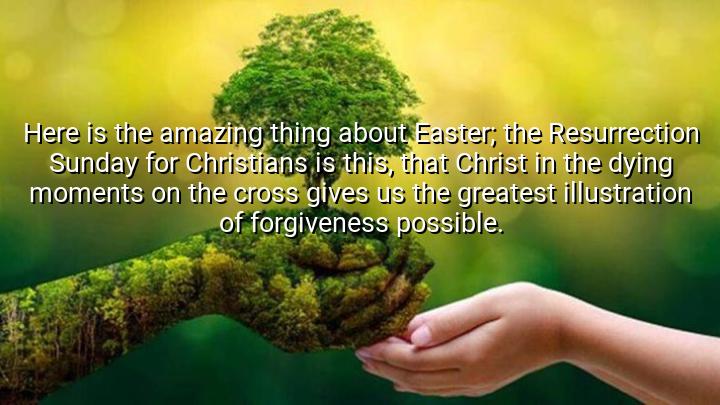




The quote "Here is the amazing thing about Easter; the Resurrection Sunday for Christians is this, that Christ in the dying moments on the cross gives us the greatest illustration of forgiveness possible." by T. D. Jakes reflects on the profound significance of Easter and Resurrection Sunday in the Christian faith. Jakes emphasizes the sacrifice and forgiveness demonstrated by Christ during His final moments on the cross. He suggests that Christ's willingness to forgive those who wronged Him, even in the face of immense suffering, serves as the ultimate example of compassion and forgiveness for believers.
T. D. Jakes, a prominent pastor, author, and speaker, is known for his powerful sermons and deep insights into faith. In this quote, he highlights the spiritual and moral lesson of forgiveness that Christians associate with Easter. The Resurrection symbolizes not only Christ’s victory over death but also His profound ability to forgive humanity, showing how the act of forgiveness transcends human suffering and provides hope for redemption.
The origin of this quote likely stems from Jakes' reflections on the meaning of Easter within the context of his faith and ministry. As a Christian leader, Jakes often speaks about the spiritual significance of key events in the Christian calendar, such as Christ's death and resurrection, and how they embody core teachings of the faith, including forgiveness, grace, and salvation. His words encourage believers to embrace these values and live them out in their own lives.
Ultimately, Jakes' quote underscores the transformative power of forgiveness and how it is exemplified in the ultimate act of Christ’s sacrifice. It calls attention to the idea that forgiveness is not just an abstract concept but something that can be lived out and practiced, especially in the face of great adversity. The lesson of Christ’s forgiveness on the cross serves as a guide for how Christians are encouraged to forgive others, no matter the circumstances.

KDkhanh dao
Hearing this interpretation of Easter makes me think: do we focus enough on forgiveness during our modern celebrations of the holiday? So much of Easter today is commercialized—eggs, bunnies, and brunch. Should churches and communities be doing more to highlight the powerful moral and spiritual lessons behind it? And if so, how can that message be made relevant to younger generations who may be growing increasingly secular?
QGQuynh Giao
I appreciate the emotional and spiritual weight of this quote, but I also find myself wondering—how can this message resonate with people who don’t share the same faith background? Is there a universal lesson here about letting go of bitterness and offering grace, or is it something only fully appreciated within the Christian tradition? I'd be interested in hearing how interfaith audiences interpret this message.
MLMy Lien
This quote made me reflect on how central forgiveness is to the Christian faith. But I sometimes struggle with how forgiveness is taught versus how it's lived. Are we too quick to jump to forgiveness without processing pain or justice? How do we balance the emotional depth of Christ’s sacrifice with the very human need for healing and accountability in our own lives?
LTNgoc Mid Le Thi
T. D. Jakes touches on something that always gives me pause—the power of forgiveness. But I wonder, can such a radical act of grace truly be replicated by ordinary people? Is it realistic to expect us to forgive those who’ve deeply wronged us, or is that standard only attainable by someone divine? How do we bridge the gap between admiration of that act and actual personal application of it?
TTThanh Truc
This perspective on Easter adds such emotional weight to the holiday, shifting the focus from celebration to reflection. I'm curious though—how do different Christian denominations interpret this act of forgiveness? Do they all emphasize it equally during Easter, or are there theological nuances that affect how it's understood and preached? I'd love to hear how cultural context might also influence this interpretation.