

He who marvels at the beauty of the world in summer will find equal cause for wonder and admiration in winter.
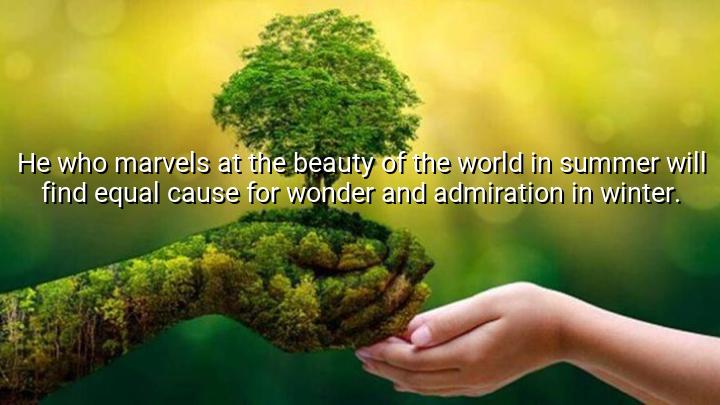




In this quote, John Burroughs, an American naturalist and essayist, highlights the idea that the beauty of nature is not confined to one season but can be found throughout the year. He suggests that those who appreciate the wonders of the world in summer, when nature is vibrant and full of life, should be able to find equal admiration for the quieter, often overlooked beauty of winter. Burroughs encourages a mindset of seeing beauty not as something limited to particular moments or conditions but as a constant presence in nature, regardless of the season.
Burroughs' message is about developing a deeper appreciation for the subtle beauty that can be found in all phases of nature, even in the more barren or stark seasons like winter. Instead of seeing winter as a time of dormancy, he invites people to look beyond the surface and appreciate the unique aspects of the season—whether it’s the serenity of snow-covered landscapes or the clarity of the cold, crisp air. This mindset helps foster a more holistic connection with nature, finding beauty in both extremes.
The origin of this quote can be traced to Burroughs’ lifelong fascination with nature and his writings on the subject. As a prominent figure in the naturalist movement, he often explored the relationship between humans and the natural world. Burroughs’ work encouraged readers to observe nature closely and find value in every aspect of the environment, from the lushness of summer to the quiet stillness of winter.
Ultimately, Burroughs’ quote reminds us that beauty is a universal quality that transcends seasons. It encourages us to appreciate the world around us in all its forms and to find wonder and admiration in the changes that nature undergoes throughout the year. By adopting this perspective, we can cultivate a deeper sense of gratitude and connection to the environment, seeing the world’s beauty in every moment.

AAdministratorAdministrator
Welcome, honored guests. Please leave a comment, we will respond soon