

He who learns but does not think, is lost! He who thinks but does not learn is in great danger.
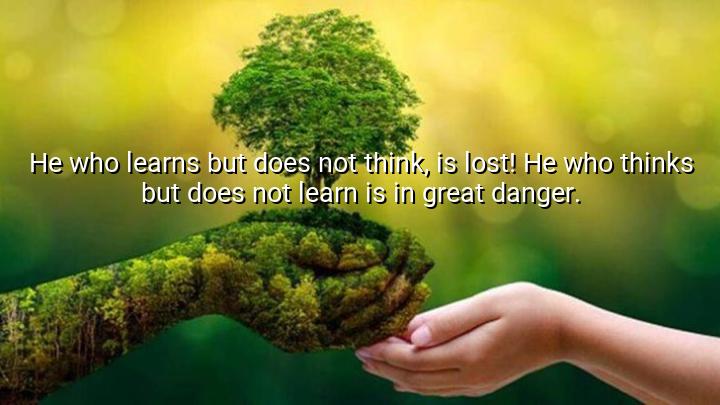




In this quote, Confucius highlights the critical relationship between learning and thinking, suggesting that both are necessary for personal growth and understanding. He argues that simply learning without thinking leads to being lost, implying that knowledge alone is not enough. Without reflection and critical thinking, one cannot fully understand or apply what is learned, leading to confusion or misguided actions. This part of the quote emphasizes the importance of engaging with knowledge rather than passively absorbing information.
On the other hand, Confucius warns that someone who thinks but does not learn is in great danger. Here, he suggests that without acquiring new knowledge or understanding, thinking alone can become shallow or disconnected from reality. A person who doesn't continuously learn may rely on outdated or incorrect assumptions, leading to poor decisions or missed opportunities. This part of the quote stresses that knowledge and thinking must work together to create wisdom and insight.
The quote reflects Confucius' belief in the balance between action and reflection, both of which are vital to personal and intellectual growth. It implies that true wisdom is achieved when one not only seeks to learn but also critically examines and applies what is learned, as well as remains open to continuous growth and understanding.
Ultimately, Confucius’ words encourage a more active approach to both learning and thinking, suggesting that balance is key. While learning provides the foundation, thinking ensures that knowledge is used wisely, and the continuous process of both will lead to greater wisdom and insight.

AAdministratorAdministrator
Welcome, honored guests. Please leave a comment, we will respond soon