

He is happiest, be he king or peasant, who finds peace in his home.
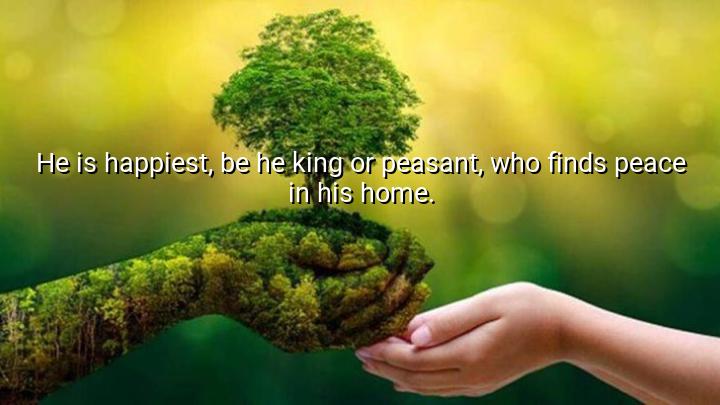




In this quote, Johann Wolfgang von Goethe emphasizes the universal importance of peace and contentment, regardless of one's social status or material wealth. He suggests that true happiness is not determined by one's position in society, whether as a king or a peasant, but by the sense of peace one finds within their home. For Goethe, the home is not just a physical space, but a sanctuary where individuals can experience emotional and psychological fulfillment, free from external pressures and societal expectations.
Goethe’s words reflect the idea that internal peace—the ability to find comfort and contentment in one’s own surroundings—trumps external markers of success or power. The reference to both a king and a peasant implies that happiness is not dependent on wealth or status but on the quality of one's personal life and the inner tranquility one can cultivate. This universal truth resonates with the notion that all individuals, regardless of their circumstances, can find profound satisfaction in the simple, grounding aspects of life.
The quote also speaks to the importance of balance in life. Peace in the home can serve as a foundation for overall well-being, as it provides a sense of stability and harmony. It is in these quiet, intimate spaces that individuals can recharge, reflect, and form meaningful connections with loved ones. Goethe suggests that those who can cultivate such an environment are truly blessed, regardless of their external achievements.
Originating from Johann Wolfgang von Goethe, a German writer, poet, and philosopher, this quote reflects his deep understanding of human nature and the pursuit of happiness. Goethe often explored themes of personal development, inner peace, and the complexities of the human condition. Through this quote, he reminds us that true fulfillment comes not from external accomplishments but from the inner peace we find in our most personal spaces.

AAdministratorAdministrator
Welcome, honored guests. Please leave a comment, we will respond soon