

Happiness is neither without us nor within us. It is in God, both without us and within us.
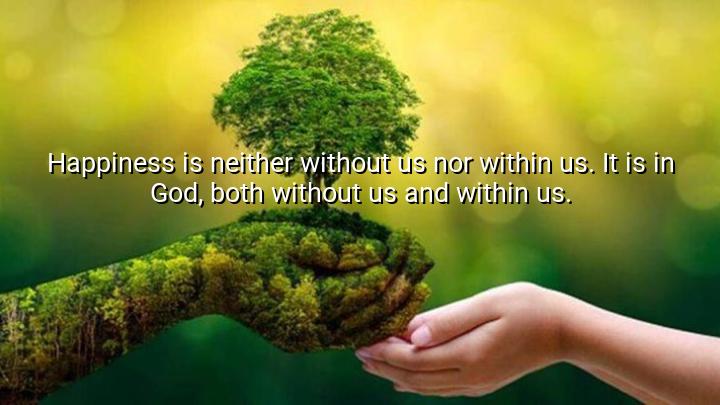




Blaise Pascal’s quote, "Happiness is neither without us nor within us. It is in God, both without us and within us," reflects his deeply spiritual perspective on happiness. Pascal suggests that true happiness cannot be found solely in external circumstances (without us) or in our own inner state (within us). Instead, it is found in God, transcending the individual and the external world. This implies that happiness is not something we can independently create or find, but something that is rooted in a higher divine source.
The quote emphasizes the idea that happiness is not bound by worldly conditions or internal emotional states alone. It can only be fully realized through a connection with God, who embodies both the external and internal sources of happiness. By acknowledging both the spiritual and existential dimensions of human life, Pascal suggests that divine presence is the true foundation of happiness, and that it permeates every aspect of our existence.
Blaise Pascal, a French mathematician, physicist, and philosopher, was deeply influenced by his religious beliefs, particularly within the Christian tradition. His works, especially his Pensées, often explore the tension between faith and reason, emphasizing the role of God in understanding the human experience. This quote reflects his belief that happiness, like other aspects of life, is ultimately centered around divine will and presence.
Ultimately, Pascal’s quote invites us to recognize that happiness is not merely a matter of personal achievement or inner peace but is instead part of a greater spiritual reality. It encourages a sense of humility, urging us to look beyond ourselves and external circumstances, seeking fulfillment through a connection with God, who is both the source and the sustainer of true joy.

AAdministratorAdministrator
Welcome, honored guests. Please leave a comment, we will respond soon