

Happiness is mostly a by-product of doing what makes us feel fulfilled.
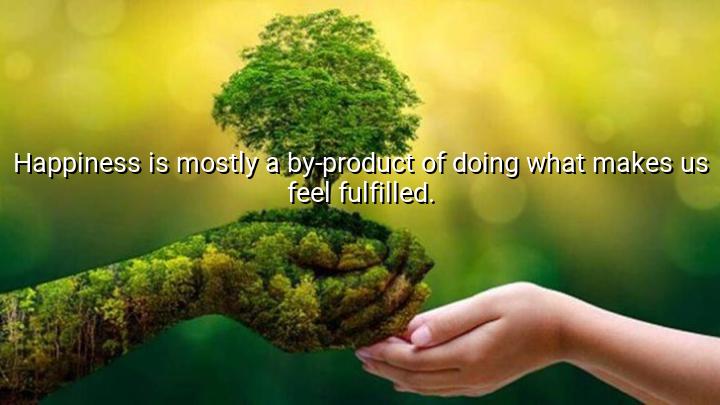




The quote by Benjamin Spock, "Happiness is mostly a by-product of doing what makes us feel fulfilled," suggests that happiness is not something that can be directly pursued or obtained as an end goal. Instead, it arises naturally when we engage in activities that bring us a sense of purpose, meaning, and personal satisfaction. Spock emphasizes that fulfillment, rather than the pursuit of happiness itself, is the key to living a joyful and contented life. By focusing on doing what feels true to our passions and values, happiness becomes a natural outcome of that process.
The origin of this quote lies in the philosophy of Benjamin Spock, a renowned American pediatrician and author of The Common Sense Book of Baby and Child Care. Although Spock is best known for his advice on child-rearing, he also explored broader topics related to well-being and the psychology of human happiness. Spock’s approach to parenting focused on the importance of emotional fulfillment, balance, and personal growth, which reflects his belief that true happiness is found not through material pursuits but through engaging in meaningful, purpose-driven actions.
Spock’s insight challenges the typical notion that happiness is something to be actively chased, often through external rewards like success or wealth. Instead, he suggests that happiness emerges when we are engaged in activities that align with our authentic selves—those things that make us feel accomplished and content. This perspective encourages individuals to focus on personal fulfillment, whether through work, relationships, or personal growth, knowing that happiness will follow as a natural consequence of a life lived with purpose.
Ultimately, this quote reminds us that happiness is not a destination to be reached but a by-product of living in accordance with our values and passions. By committing to what makes us feel fulfilled—whether it's through creative pursuits, helping others, or personal development—we cultivate a deeper, more lasting sense of joy that arises naturally, without needing to be forced or artificially manufactured.

AAdministratorAdministrator
Welcome, honored guests. Please leave a comment, we will respond soon