

Happiness is a matter of one's most ordinary and everyday mode of consciousness being busy and lively and unconcerned with self.
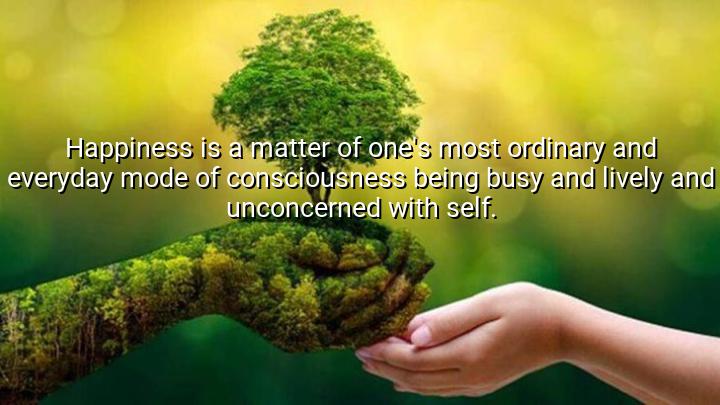




In this quote, Iris Murdoch, the British author and philosopher, presents a view of happiness that is rooted in the everyday experience and in a state of mindfulness. Murdoch suggests that true happiness arises when one's mode of consciousness is engaged in the present moment—busy, lively, and focused on the world around them, rather than on self-absorption or self-centered thoughts. Happiness, in her view, comes not from external achievements or material success but from an inner state of awareness and engagement with life as it is.
Murdoch emphasizes the importance of being unconcerned with self, which can be interpreted as letting go of ego and self-importance. In this view, happiness is found in the ability to live freely, without being trapped by one’s personal concerns or worries. By focusing on the present moment and the people or tasks at hand, one can experience a more natural, authentic form of happiness that is not dependent on external factors or internal desires.
The origin of this quote is consistent with Murdoch’s broader philosophical and literary explorations, which often centered on the nature of morality, selflessness, and love. In her works, Murdoch frequently examined how focusing on others and stepping outside one’s own ego could lead to greater understanding and personal fulfillment. This quote reflects her belief that happiness is a byproduct of self-forgetfulness and the willingness to be present in life’s simple, ordinary moments.
Ultimately, Murdoch’s message is that happiness doesn’t come from seeking it out as a goal, but from living fully in the present and being open to the world. By focusing less on the self and more on the experience of life, one can cultivate a deeper, more enduring sense of joy and contentment.

AAdministratorAdministrator
Welcome, honored guests. Please leave a comment, we will respond soon