

Happiness, I do not know where to turn to discover you on earth, in the air or the sky; yet I know you exist and are no futile dream.
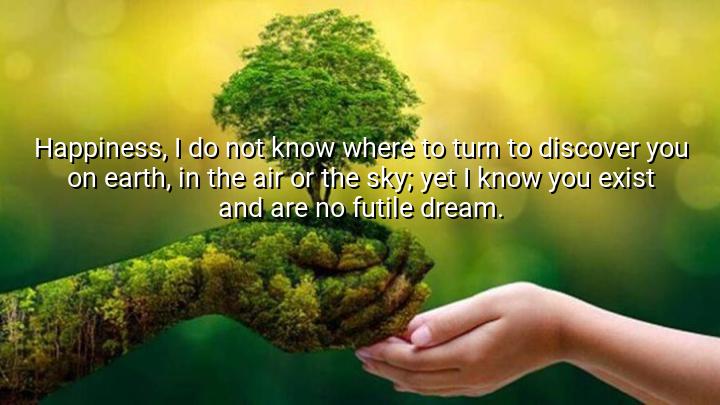




In this quote, Rosalía de Castro expresses the complexity and elusiveness of happiness, acknowledging that it is difficult to pinpoint its exact location or source. She confesses uncertainty about where to find happiness, whether it exists on earth, in the air, or in the sky. Despite this uncertainty, she affirms that happiness is real and not just an unattainable or illusory dream. Castro's words convey the idea that happiness is a tangible force that exists, even if its exact nature or location is hard to define.
Castro's reflection on happiness highlights its intangible and abstract qualities, suggesting that it is something that cannot be easily grasped or fully understood. However, by acknowledging its existence, she implies that happiness can be found or experienced in different forms, even if its precise nature remains elusive. Her recognition of happiness as a non-futile, real concept also suggests that it is something worth seeking and cherishing, even if we don’t always know where to look for it.
The origin of this quote comes from Rosalía de Castro, a Spanish poet and novelist who is often regarded as one of the most important figures in Galician literature. Known for her work in both Galician and Spanish, de Castro explored themes of identity, nature, and existential questions, often delving into the emotional and psychological complexities of the human experience. This quote reflects her poetic exploration of human emotions, particularly the elusive nature of happiness and the human longing for it.
Ultimately, de Castro’s words remind us that happiness is not always something we can easily define or find. Its elusive nature does not make it any less real or worth pursuing. The quote encourages us to recognize that happiness exists in various forms, even if we cannot always pinpoint its location or fully understand its essence.

AAdministratorAdministrator
Welcome, honored guests. Please leave a comment, we will respond soon