

Happiness depends upon ourselves.
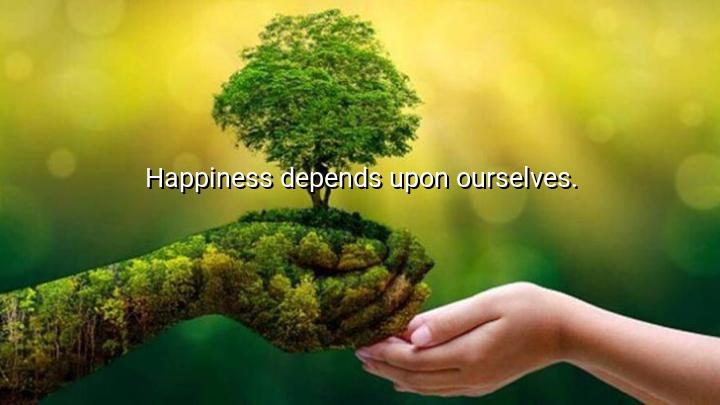




Aristotle’s quote, "Happiness depends upon ourselves," encapsulates his belief in personal responsibility and the power of the individual in shaping their own well-being. According to him, happiness is not determined by external circumstances or material wealth, but by how one chooses to live and engage with life. The idea is that individuals have the power to cultivate their own happiness through their actions, attitudes, and decisions.
In his philosophy, happiness or eudaimonia (often translated as flourishing or well-being) is achieved by living a life of virtue. Aristotle argues that by practicing virtues such as wisdom, courage, and moderation, one can achieve a state of contentment and fulfillment. This reinforces the idea that true happiness comes from internal rather than external sources.
The quote is a central tenet of Aristotle's ethical teachings, particularly in his work, Nicomachean Ethics. In this text, he emphasizes that happiness is the ultimate goal of human life, and it is something that individuals must actively pursue. It is within one’s control to create a life of meaning and purpose.
Ultimately, Aristotle’s quote challenges the idea that happiness is something to be found outside oneself, urging us to look inward for the qualities and actions that lead to a fulfilled life. It highlights the importance of self-awareness, personal growth, and the pursuit of virtue as the keys to lasting contentment.

AAdministratorAdministrator
Welcome, honored guests. Please leave a comment, we will respond soon