

Government is an unnecessary evil. Human beings, when accustomed to taking responsibility for their own behavior, can cooperate on a basis of mutual trust and helpfulness.
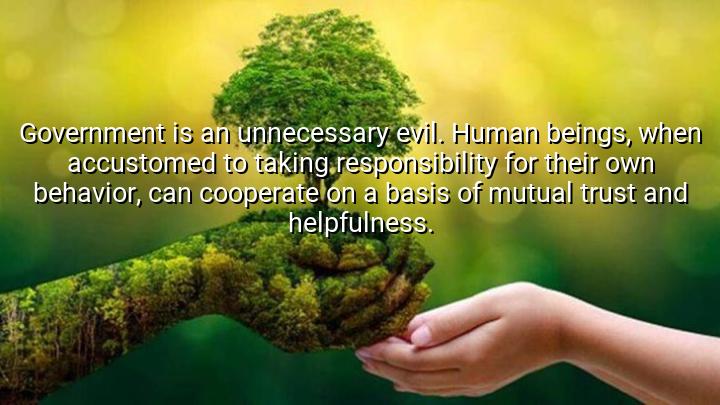




The quote by Fred Woodworth, a writer and anarchist, critiques the role of government in society. By stating, "Government is an unnecessary evil," Woodworth expresses the belief that government inherently causes harm or restriction on individuals, even if it is intended to serve. He argues that government is not a necessary force for societal organization, and that humans, when left to their own devices, are capable of managing their relationships and communities without coercion or oversight.
Woodworth further suggests that human beings, when accustomed to taking responsibility for their own actions, are capable of cooperating through mutual trust and helpfulness. He envisions a society where individuals are not reliant on a government to enforce laws or rules but instead act ethically and cooperatively. In this view, people would naturally form supportive communities based on trust, understanding, and the desire to help each other without the need for imposed authority.
This quote is rooted in anarchist philosophy, which advocates for the abolition of centralized government and the promotion of voluntary, decentralized forms of organization. Woodworth suggests that humans have the capacity for self-governance and can function in harmony without the need for a controlling power. His perspective contrasts with more conventional views of government, which see it as a necessary entity to maintain order and protect individual rights.
Ultimately, Woodworth’s quote challenges the traditional notion of government as an essential force in society, promoting the idea that true freedom and cooperation can arise from individuals taking personal responsibility and engaging with each other based on trust rather than force. It invites reflection on the role of authority and whether it is truly needed for societal progress and harmony.

AAdministratorAdministrator
Welcome, honored guests. Please leave a comment, we will respond soon