

General benevolence, but not general friendship, made a man what he ought to be.
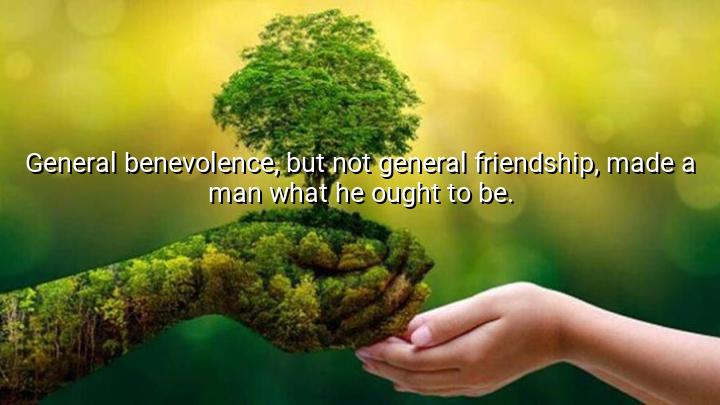




Jane Austen’s quote explores the distinction between benevolence and friendship in shaping a person’s character. She suggests that while benevolence—or a general kindness and goodwill toward others—is important for making a person virtuous, it is not the same as friendship. In her view, benevolence is a broader and more universal quality that contributes to one’s moral integrity, while friendship is a more specific and intimate connection that may not be necessary to define a person’s worth.
The quote highlights that a person should aim to be kind and compassionate to all, regardless of their relationship with them. General benevolence is about caring for others and contributing to the well-being of society, while friendship, which often involves a closer, more selective bond, is not a requirement for being a good or honorable person. Austen is making a subtle critique of the idea that friendship is the sole or most important measure of one’s character.
By suggesting that friendship is not essential to being what "a man ought to be," Austen points out that moral and ethical qualities can exist independently of personal relationships. Friendship can enrich one’s life, but a person can still be virtuous without having deep personal connections. Austen’s quote suggests that character is built on actions of kindness, respect, and general good will, not necessarily by cultivating close friendships.
Originating from Jane Austen, a renowned English novelist famous for her keen insights into society and human nature, this quote reflects her broader themes of virtue, social norms, and relationships. Austen often examined the complexities of human behavior and relationships in her novels, and in this quote, she emphasizes that true virtue is about one’s broader attitudes and actions, rather than the specific relationships one holds.

AAdministratorAdministrator
Welcome, honored guests. Please leave a comment, we will respond soon