

From a child, I had an inordinate desire for knowledge and especially music, painting, flowers, and the sciences, Algebra being one of my favorite studies.
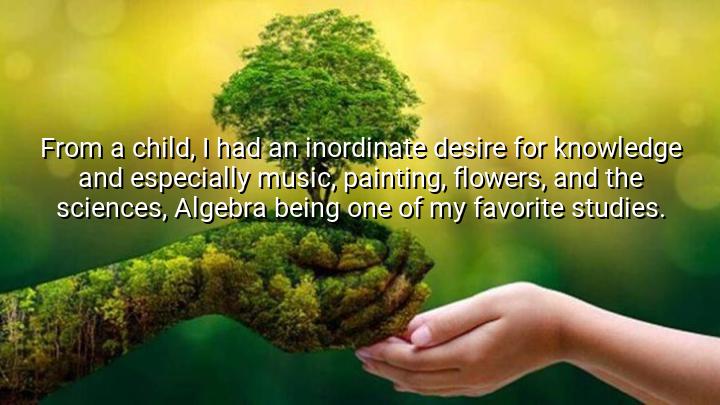




The quote “From a child, I had an inordinate desire for knowledge and especially music, painting, flowers, and the sciences, Algebra being one of my favorite studies.” is attributed to George Washington Carver, the renowned American scientist, educator, and inventor. In this reflection, Carver describes his early and intense passion for knowledge, highlighting his love for both the arts and the sciences. His words reveal a natural curiosity and a deep appreciation for beauty in multiple forms, from music and painting to flowers and mathematics.
The origin of this statement can be traced to Carver’s childhood, when he grew up in poverty as the son of enslaved parents. Despite significant obstacles—limited access to education and widespread racial discrimination—Carver pursued learning wherever he could find it. His interests were not confined to a single field but stretched across creative and scientific disciplines. By recalling Algebra as one of his favorite studies, he underscores how intellectual curiosity drove him beyond the boundaries of his circumstances.
The meaning of the quote illustrates the importance of cultivating curiosity from an early age. Carver’s diverse interests show that knowledge is not limited to practical pursuits but also includes appreciation for the beauty of nature and the arts. His desire to learn reflects a holistic view of education—where both creativity and logic work together to expand human understanding.
Ultimately, Carver’s reflection serves as an inspiring reminder that the thirst for learning can overcome even the greatest barriers. His lifelong achievements in agricultural science, innovation, and education were rooted in the same childhood curiosity he describes. By embracing knowledge in all its forms, Carver demonstrated how passion for learning can lead not only to personal growth but also to contributions that benefit humanity.

AAdministratorAdministrator
Welcome, honored guests. Please leave a comment, we will respond soon