

Freedom is not an ideal, it is not even a protection, if it means nothing more than freedom to stagnate, to live without dreams, to have no greater aim than a second car and another television set.
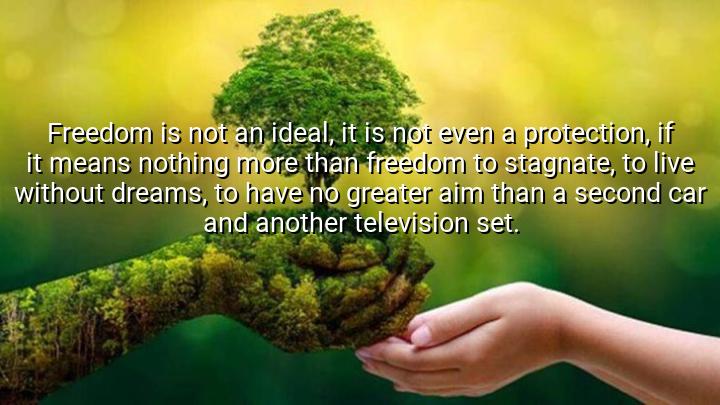




The quote "Freedom is not an ideal, it is not even a protection, if it means nothing more than freedom to stagnate, to live without dreams, to have no greater aim than a second car and another television set" by Adlai Stevenson II critiques a shallow conception of freedom. Stevenson, a U.S. politician and diplomat, is arguing that true freedom should not be reduced to mere materialism or consumerism. He contends that if freedom only allows people to pursue material possessions and comforts, without any deeper sense of purpose, growth, or aspiration, then it has lost its true value.
Stevenson is suggesting that freedom should be more than the ability to acquire more possessions or simply exist in a comfortable state. Instead, it should be about the freedom to pursue meaningful dreams, personal growth, and higher aspirations. Without these elements, he argues, freedom becomes an empty concept, offering little more than the ability to maintain the status quo and live a life of stagnation. This reflects a belief that freedom is tied not just to material conditions but also to the pursuit of ambition and purpose.
The origin of this quote comes from Stevenson’s broader worldview as an advocate for human dignity and progress. As a political figure, Stevenson was deeply concerned with the direction of American society during the mid-20th century. He saw the focus on material gain and the pursuit of consumer goods as a form of cultural decline, where people could enjoy physical freedom but were spiritually and intellectually impoverished. His words reflect a desire for a more profound, humanistic understanding of freedom, one that encourages individuals to reach for something beyond the superficial.
Ultimately, the quote challenges us to reconsider what it means to be truly free. For Stevenson, freedom should be about more than just personal liberties or consumer choices; it should be about the freedom to grow, to dream, and to strive for a higher purpose. In this sense, true freedom involves the capacity for self-realization and the pursuit of meaningful goals, not just the ability to accumulate more material goods.

AAdministratorAdministrator
Welcome, honored guests. Please leave a comment, we will respond soon