

Forms in nature are a byproduct of a reciprocal action between a given material and the conditions of the environment. But in architecture, the process is the direct opposite: First you decide on the form, and then you think how to build it in reality.
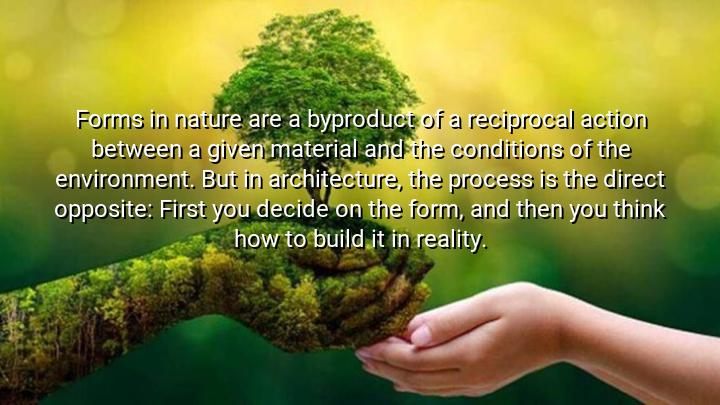




Neri Oxman’s quote, “Forms in nature are a byproduct of a reciprocal action between a given material and the conditions of the environment. But in architecture, the process is the direct opposite: First you decide on the form, and then you think how to build it in reality,” contrasts the organic evolution of natural structures with the top-down approach often used in traditional architectural design. In nature, form emerges from the interplay between materials and external forces such as gravity, climate, and growth conditions. In contrast, architecture typically begins with an idealized design, which is then engineered into existence, sometimes without full consideration of material behavior or environmental adaptation.
The origin of this quote stems from Oxman’s groundbreaking work in material ecology and computational design at the MIT Media Lab. As an architect, designer, and scientist, she advocates for a new paradigm where design, engineering, and biology converge. Her projects frequently explore how materials can self-organize, and how building forms can be informed by natural processes rather than imposed upon them. This philosophy stands in contrast to conventional methods, where form is often determined by aesthetic or symbolic intent first, and material concerns are addressed later.
By highlighting the reverse logic of traditional architecture, Oxman challenges architects to rethink the design process. She envisions a future where architecture mimics biology, allowing materials and environmental factors to help shape form from the beginning. This would create buildings that are not only more efficient and sustainable, but also more resilient and responsive to their surroundings, much like organisms adapt to their habitats.
Ultimately, Oxman’s quote promotes a shift from form-first thinking to a material-driven and context-sensitive design methodology. It urges architects to embrace nature’s intelligence—to design as nature builds—resulting in structures that are more harmonious, innovative, and alive. This approach aligns architecture with ecological principles, paving the way for a more integrated and evolutionary future of design.

AAdministratorAdministrator
Welcome, honored guests. Please leave a comment, we will respond soon