

Food for us comes from our relatives, whether they have wings or fins or roots. That is how we consider food. Food has a culture. It has a history. It has a story. It has relationships.
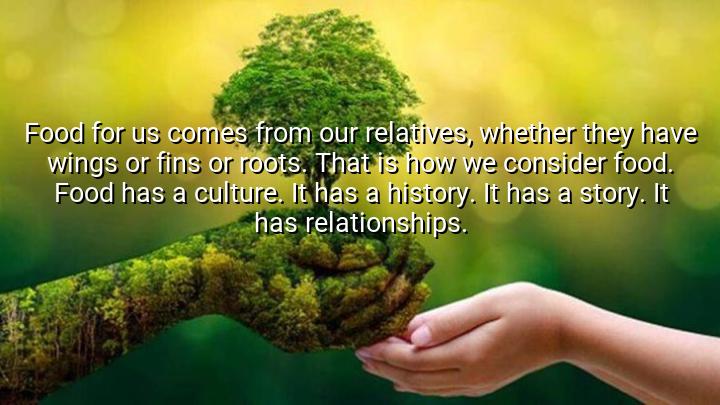




This quote by Winona LaDuke, “Food for us comes from our relatives, whether they have wings or fins or roots. That is how we consider food. Food has a culture. It has a history. It has a story. It has relationships,” reflects a deeply Indigenous worldview that regards food not merely as sustenance, but as a sacred connection to the natural world and to community. By referring to animals and plants as “relatives,” LaDuke emphasizes the kinship between humans and the environment, a belief that is central to many Native American cultures. This view fosters a profound sense of respect, gratitude, and responsibility toward the sources of nourishment.
LaDuke, an Indigenous environmentalist, activist, and author, has long advocated for food sovereignty—the right of people to define their own food systems and protect traditional agricultural practices. Her quote likely comes from her efforts to revitalize Native foodways and preserve ecological balance. In this context, she underscores that food is not transactional—it’s relational, carrying with it stories, ancestral knowledge, and cultural memory.
The phrase “food has a culture… a story… relationships” urges us to consider the origins and meaning of what we eat. Rather than seeing food as a product from a store or factory, LaDuke encourages a reconnection with land, seasonality, and the living beings involved in its production. This perspective challenges modern, industrialized food systems that often depersonalize and exploit natural resources, disconnecting people from the ecosystems that sustain them.
Ultimately, LaDuke’s quote is a call to rethink our relationship with food. It asks us to view eating as an act of reciprocity and cultural expression, not just consumption. In doing so, we honor the interconnectedness of life, preserve biodiversity, and sustain the traditions that nourish both our bodies and our communities.

AAdministratorAdministrator
Welcome, honored guests. Please leave a comment, we will respond soon