

Fishes live in the sea, as men do a-land; the great ones eat up the little ones.
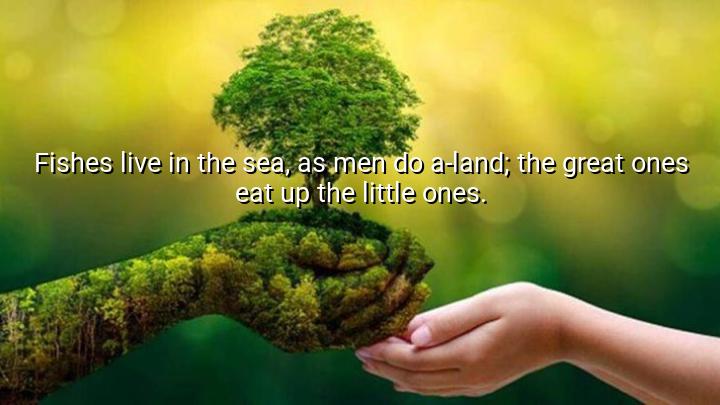




William Shakespeare’s quote compares the nature of human society to that of fish in the sea, illustrating the concept of dominance and hierarchy. The idea that "the great ones eat up the little ones" suggests that those in positions of power or strength tend to exploit or overpower the weaker or smaller individuals in society. This analogy highlights the inequality present in both the animal kingdom and human social structures, where the strong often have an unfair advantage over the weak.
Shakespeare’s reference to fishes and the sea serves as a metaphor for society and its dynamics. Just as in the ocean, where larger fish prey on smaller ones, human society often sees those with more power or resources consuming or taking advantage of those with less. This reflects a critical view of the social order, where the disparities between different classes or groups can lead to exploitation and unfair treatment.
The quote is also a commentary on the cycle of power and the idea that those who are weaker are often at the mercy of the stronger forces around them. Shakespeare, through this imagery, seems to suggest that inequality is not a new or unique phenomenon but is inherent in the way both nature and human society function. It evokes the idea of the survival of the fittest, where power dynamics are shaped by strength, size, or influence.
The origin of this quote comes from Shakespeare’s play King Lear, where themes of power, corruption, and human nature are explored. In the play, the quote reflects the cruelty and selfishness of those in power, using the natural world to parallel human behavior. Shakespeare’s observation about the unequal nature of life and society remains relevant, as it continues to shed light on the ways power is distributed and abused in modern times.

AAdministratorAdministrator
Welcome, honored guests. Please leave a comment, we will respond soon