

Faith means belief in something concerning which doubt is theoretically possible.
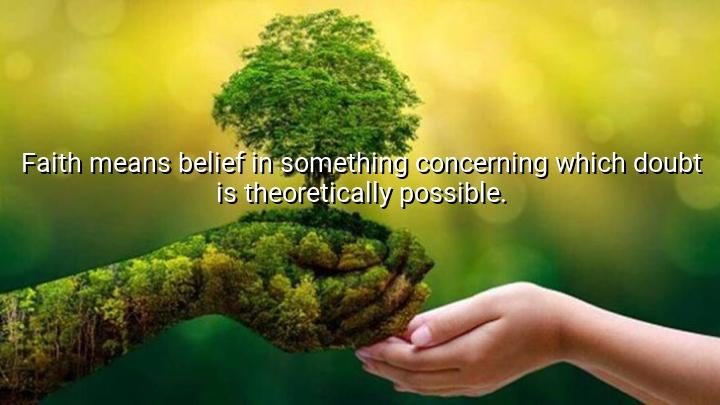




The quote by William James, "Faith means belief in something concerning which doubt is theoretically possible," defines faith as a conscious choice to believe despite the presence of potential doubt. James highlights that faith is not blind or unquestioning but involves embracing beliefs even when uncertainty exists. This definition underscores faith as a courageous act of commitment amid ambiguity and the lack of absolute proof.
The origin of this quote lies in James’s work as a pioneering American philosopher and psychologist, often regarded as one of the founders of pragmatism. In his influential book, The Will to Believe, James argued that faith is a legitimate and necessary response when evidence is inconclusive but a decision is required. His perspective framed faith as an active, practical choice rather than passive acceptance.
This quote challenges the idea that faith requires complete certainty or empirical proof. Instead, it portrays faith as a deliberate acceptance of possibility, acknowledging that doubt may exist but choosing to believe anyway. James emphasizes the human capacity to commit to beliefs that cannot be fully verified but are meaningful and motivating.
In essence, James’s words invite us to view faith as a vital part of human decision-making, especially in uncertain situations. Faith, for him, is about making a commitment based on hope and conviction, even when doubt remains, highlighting the dynamic interplay between belief and uncertainty.

AAdministratorAdministrator
Welcome, honored guests. Please leave a comment, we will respond soon