

Faith indeed tells what the senses do not tell, but not the contrary of what they see. It is above them and not contrary to them.
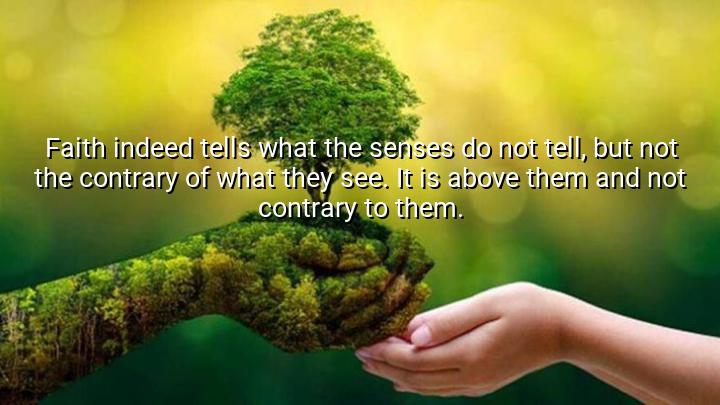




The quote by Blaise Pascal, "Faith indeed tells what the senses do not tell, but not the contrary of what they see. It is above them and not contrary to them," emphasizes the harmonious relationship between faith and sensory experience. Pascal explains that faith reveals truths beyond the reach of our physical senses—it provides insight into spiritual realities that cannot be seen or measured. However, faith does not contradict what our senses perceive; instead, it transcends and complements sensory knowledge, existing on a higher plane rather than opposing it.
The origin of this quote comes from Pascal’s work in Pensées, where he explores the limits of human reason and the nature of faith. Pascal, a mathematician and Christian philosopher, sought to bridge faith and reason by arguing that faith goes beyond what is empirically verifiable but does not negate or deny the evidence provided by the senses. His perspective encourages believers to respect scientific observation while embracing the deeper spiritual truths that faith uncovers.
This quote challenges the idea that faith is irrational or opposed to reason and sensory evidence. Instead, it presents faith as a higher form of knowledge that coexists with and enhances what we learn through our senses. Faith acknowledges the physical world but also opens the door to mysteries and realities beyond it.
In essence, Pascal’s words encourage a balanced view of faith and reason. Faith is not about rejecting what we see but about trusting in what lies beyond our immediate perception, fostering a respectful integration of both spiritual insight and sensory experience.

AAdministratorAdministrator
Welcome, honored guests. Please leave a comment, we will respond soon