

Everything tends to make us believe that there exists a certain point of the mind at which life and death, the real and the imagined, past and future, the communicable and the incommunicable, high and low, cease to be perceived as contradictions.
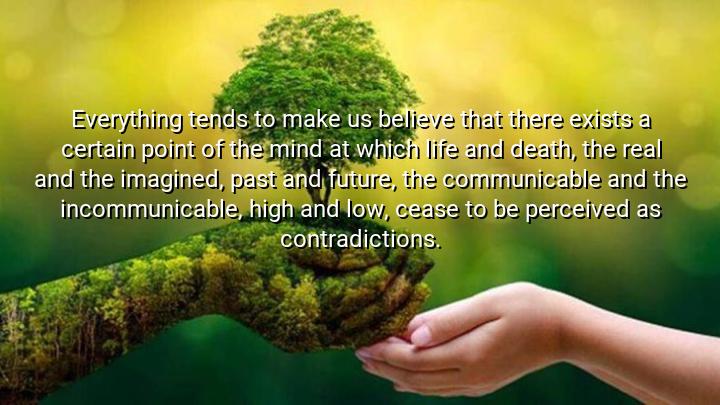




In this quote, André Breton, a French writer and one of the founders of Surrealism, explores the idea that there exists a state of the mind where opposites and contradictions no longer hold the same significance. He suggests that concepts like life and death, the real and the imagined, the past and the future, as well as the communicable and the incommunicable, eventually merge in the mind. In this state, these dualities no longer appear as separate or contradictory, reflecting a deeper level of understanding where all things are interconnected.
Breton’s statement draws on Surrealist philosophy, which sought to explore and challenge the boundaries of the conscious mind by bringing together seemingly unrelated or opposing ideas. The surrealists believed that by freeing the mind from logical constraints, one could tap into a more profound reality, where the boundaries between reality and imagination could dissolve. This is reflected in the idea that, in such a mental state, contradictions like high and low, or past and future, no longer create a divide but instead coexist harmoniously.
The phrase "cease to be perceived as contradictions" emphasizes how certain mental or existential experiences transcend the traditional dualities that we use to categorize the world. This notion suggests a form of unity and wholeness, where the complexities and paradoxes of life come together in a way that surpasses logical thinking. Breton implies that through deeper introspection or exploration of the unconscious, one can perceive a more integrated view of existence.
Ultimately, Breton’s quote reflects the surrealist belief in breaking down the barriers between opposites and exploring the deeper, more fluid nature of the human experience. By acknowledging that opposites can merge in the mind, he suggests that our understanding of life, death, time, and experience can become more unified and less confined to traditional ideas of duality.

AAdministratorAdministrator
Welcome, honored guests. Please leave a comment, we will respond soon