

Everything one reads is nourishment of some sort - good food or junk food - and one assumes it all goes in and has its way with your brain cells.
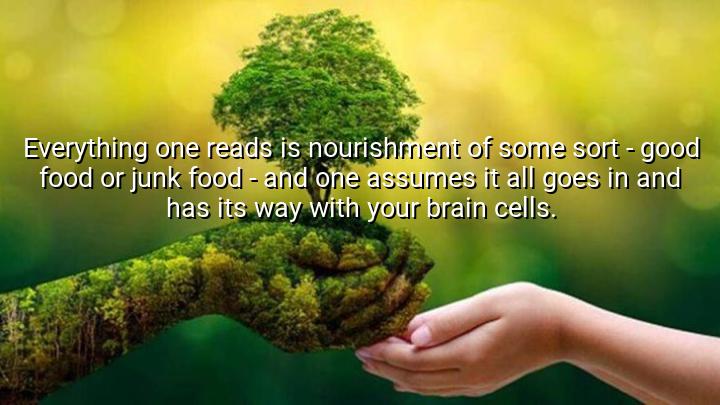




The quote "Everything one reads is nourishment of some sort – good food or junk food – and one assumes it all goes in and has its way with your brain cells." by Lorrie Moore draws a clever and insightful parallel between reading and eating, emphasizing that all literature—whether profound or trivial—has an impact on the mind. Moore, a celebrated American fiction writer known for her wit and emotional depth, uses this analogy to highlight the way that every piece of writing we consume leaves an imprint on our thoughts, language, and perspective.
By comparing reading material to “good food or junk food,” Moore suggests that not all reading is of equal quality, but all of it still feeds the brain in some way. Just like with diets, a person can consume intellectually rich content (like classic literature or thought-provoking essays) or lighter, less nutritious content (like gossip columns or sensational stories). Yet, regardless of quality, all these inputs contribute to shaping our mental landscape.
The phrase “has its way with your brain cells” adds a humorous but slightly cautionary tone. It implies that what we read doesn’t just sit passively in our minds—it interacts, influences, and even alters our thinking. Moore suggests that readers should be aware of their intellectual consumption, just as one might be mindful of their physical diet, recognizing the subtle but significant effects it has over time.
Ultimately, Moore’s quote is a reminder of the power of words and the responsibility of readers. Whether engaging with high art or casual reading, we are constantly shaping our inner world. Her message encourages both curiosity and discernment, inviting us to consider what we’re feeding our minds—and how it may transform us.

AAdministratorAdministrator
Welcome, honored guests. Please leave a comment, we will respond soon