

Every step and every movement of the multitude, even in what are termed enlightened ages, are made with equal blindness to the future; and nations stumble upon establishments, which are indeed the result of human action, but not the execution of any human design.
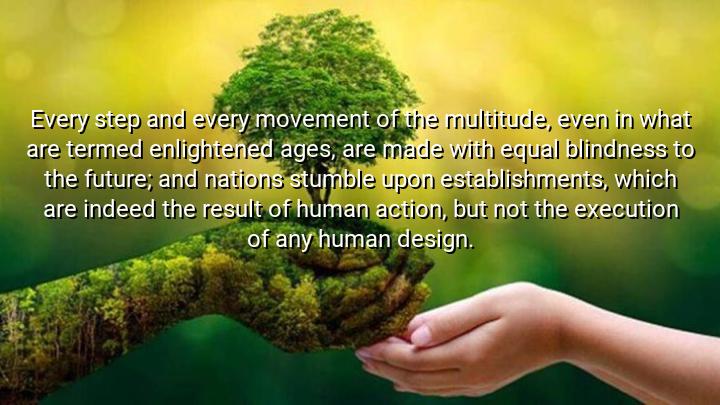




The quote by Adam Ferguson reflects his belief that human actions, even in times of great intellectual or cultural progress, are often carried out with little understanding or foresight of their long-term consequences. He suggests that individuals and nations move through life without a clear, deliberate plan for the future, often creating systems or institutions by accident rather than through conscious design. This lack of foresight means that even the most sophisticated societies can inadvertently create structures that they didn’t intend or fully understand.
Ferguson’s statement highlights the unpredictability and chaos that often arise from collective human actions. While individuals may act with good intentions or follow societal trends, the results of their actions can form complex systems that no one specifically planned. The idea that these "establishments" arise from human action yet are not the product of deliberate intention reflects a critical view of how societies evolve, often stumbling into solutions that become deeply entrenched over time.
The origin of the quote is rooted in Ferguson’s work as a philosopher and historian, particularly in his writings on the development of societies and social order. He was concerned with the forces that shape human history, and his ideas were foundational to the field of social science. His reflections on how societies create systems without fully understanding their implications align with his broader critiques of how human institutions are often developed without foresight or proper consideration of future impacts.
Ultimately, Ferguson’s quote challenges the idea of progress as a linear or fully controlled process. It suggests that human history is shaped by chance and blindness to the future, where societal structures arise from collective actions rather than from a well-thought-out design. This observation underscores the complexity of human existence and the unforeseen consequences of our decisions, encouraging a more reflective and cautious approach to how we shape our societies and institutions.

AAdministratorAdministrator
Welcome, honored guests. Please leave a comment, we will respond soon