

Every human heart cries and yearns for the same thing: a chance to fulfill his or her own dreams and desires. Even the poorest man has a dream.
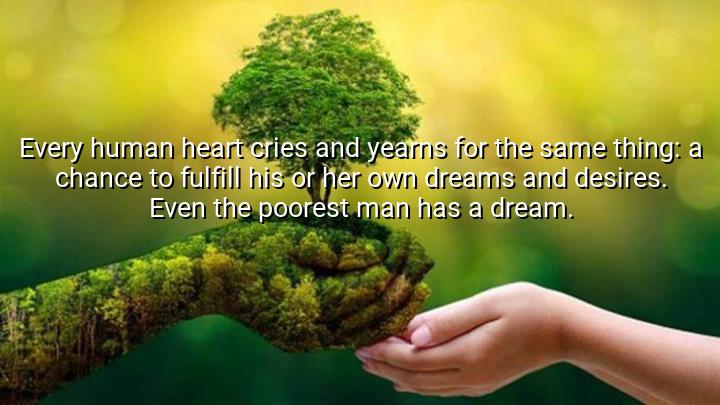




The quote by Myles Munroe highlights a universal truth about the human condition: every individual, regardless of their circumstances, has the desire to fulfill their dreams and aspirations. Munroe emphasizes that this longing is not restricted to the wealthy or privileged but extends to every person, including the poorest. Even those facing significant challenges and hardships still carry within them a vision for a better life or a deeper purpose.
Munroe’s words suggest that dreams are an intrinsic part of the human experience. They represent the hope for personal growth, achievement, and fulfillment, transcending economic status, social class, or background. By stating that “even the poorest man has a dream,” he emphasizes that desire and ambition are not limited by material wealth, but are central to the human spirit, driving individuals to seek improvement and meaning in their lives.
The origin of this quote comes from Munroe’s work as a motivational speaker, author, and leadership expert. Known for his teachings on personal development and success, Munroe often spoke about the importance of purpose and vision in shaping one’s life. His philosophy was centered on the belief that every person has potential and the ability to achieve their dreams, regardless of external challenges.
Ultimately, Munroe’s quote serves as a reminder that hope and dreams are universal, uniting all people in their shared desire to create meaning in their lives. It encourages individuals to recognize their innate potential and pursue their goals, no matter their situation. The message is one of empowerment, emphasizing that fulfilling dreams is a fundamental human need that can inspire positive change and personal growth.

AAdministratorAdministrator
Welcome, honored guests. Please leave a comment, we will respond soon