

Even scientific knowledge, if there is anything to it, is not a random observation of random objects; for the critical objectivity of significant knowledge is attained as a practice only philosophically in inner action.
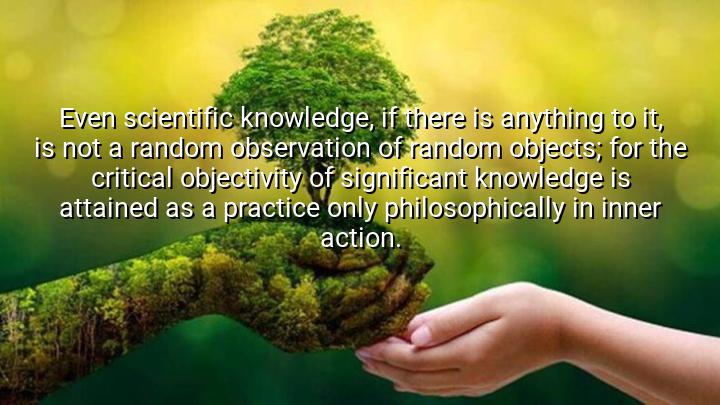




In this quote, Karl Jaspers emphasizes that even scientific knowledge is not simply the result of random observation but rather a structured and meaningful pursuit. For Jaspers, true critical objectivity requires more than detached study; it is cultivated through philosophical reflection and what he calls inner action. This suggests that knowledge, to be significant, must go beyond surface-level facts and involve a deeper engagement of the mind and spirit.
The meaning of the quote lies in Jaspers’s philosophy that science and philosophy are not opposed but complementary. While science provides data and empirical insights, the act of interpreting and understanding that knowledge requires philosophical depth. He stresses that the value of knowledge comes not just from external observation but from the inner effort to process, question, and contextualize it. This view aligns with his broader existentialist perspective that human beings must actively participate in the pursuit of truth.
The origin of the quote is rooted in Jaspers’s work as a German philosopher and psychiatrist, particularly within the context of existential philosophy in the 20th century. Living during times of political upheaval and rapid scientific progress, Jaspers sought to reconcile scientific advancements with the enduring need for philosophical inquiry. He argued that without philosophical engagement, scientific findings could become fragmented or misused, lacking a foundation in meaning and ethics.
Ultimately, Jaspers reminds us that knowledge is not passive but an active practice, requiring both empirical rigor and philosophical reflection. His perspective warns against reducing science to mechanical observation, highlighting instead the necessity of inner awareness, responsibility, and critical thought in making knowledge truly significant for humanity.
#KarlJaspers #ScientificKnowledge #Philosophy #CriticalObjectivity #InnerAction

AAdministratorAdministrator
Welcome, honored guests. Please leave a comment, we will respond soon