

Even in the centuries which appear to us to be the most monstrous and foolish, the immortal appetite for beauty has always found satisfaction.
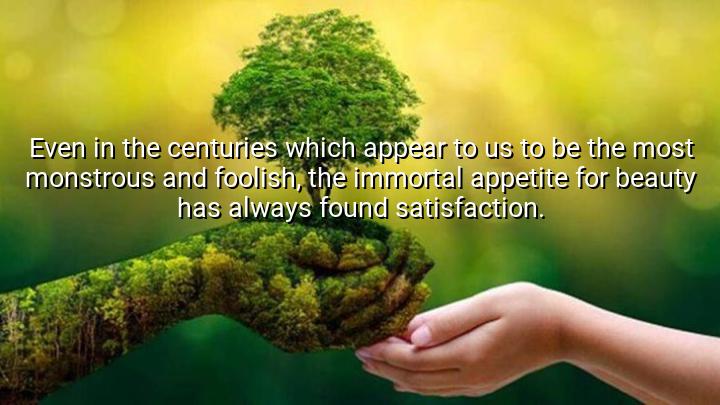




The quote by Charles Baudelaire, "Even in the centuries which appear to us to be the most monstrous and foolish, the immortal appetite for beauty has always found satisfaction," reflects Baudelaire’s belief in the timeless and enduring nature of the human desire for beauty. Baudelaire, a French poet associated with Symbolism and Romanticism, suggests that regardless of the era or societal conditions, the intrinsic longing for beauty has remained a central aspect of the human experience. Even in times of chaos or ignorance, when societies may appear monstrous or foolish, the pursuit of beauty still manages to find a way to flourish.
Baudelaire's statement also points to the resilience of the human spirit in its capacity to create and appreciate beauty, even in the most difficult or disturbing of times. He seems to argue that the aesthetic desire is immortal, transcending the limitations of historical moments. For Baudelaire, this appetite for beauty is a defining feature of humanity, one that persists regardless of the moral or intellectual state of a particular period.
Furthermore, Baudelaire's words suggest that beauty can be found and appreciated even in the most unlikely or challenging circumstances. Despite societal decay, political turmoil, or intellectual folly, there is always an undying search for beauty in both art and life. This speaks to the transformative power of beauty, capable of elevating the human condition even in difficult or dark times.
Ultimately, Baudelaire's quote emphasizes the timelessness of beauty and its central role in human life. No matter the historical context, whether we perceive a particular age as foolish or monstrous, the pursuit of beauty remains a constant, satisfying a deep and fundamental human need.

AAdministratorAdministrator
Welcome, honored guests. Please leave a comment, we will respond soon