

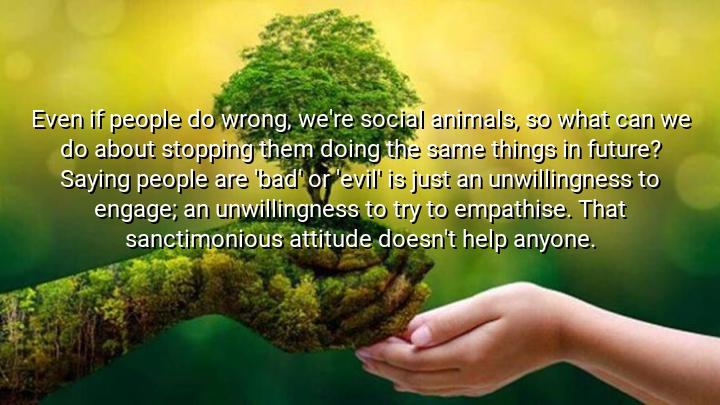
Even if people do wrong, we're social animals, so what can we do about stopping them doing the same things in future? Saying people are 'bad' or 'evil' is just an unwillingness to engage; an unwillingness to try to empathise. That sanctimonious attitude doesn't help anyone.
Even if people do wrong, we're
Even if people do wrong, we're social animals, so what can we do about stopping them doing the same things in future? Saying people are 'bad' or 'evil' is just an unwillingness to engage; an unwillingness to try to empathise. That sanctimonious attitude doesn't help anyone.

Even if people do wrong, we're
Even if people do wrong, we're social animals, so what can we do about stopping them doing the same things in future? Saying people are 'bad' or 'evil' is just an unwillingness to engage; an unwillingness to try to empathise. That sanctimonious attitude doesn't help anyone.
Even if people do wrong, we're
Even if people do wrong, we're social animals, so what can we do about stopping them doing the same things in future? Saying people are 'bad' or 'evil' is just an unwillingness to engage; an unwillingness to try to empathise. That sanctimonious attitude doesn't help anyone.
Even if people do wrong, we're
Even if people do wrong, we're social animals, so what can we do about stopping them doing the same things in future? Saying people are 'bad' or 'evil' is just an unwillingness to engage; an unwillingness to try to empathise. That sanctimonious attitude doesn't help anyone.
Even if people do wrong, we're
Even if people do wrong, we're social animals, so what can we do about stopping them doing the same things in future? Saying people are 'bad' or 'evil' is just an unwillingness to engage; an unwillingness to try to empathise. That sanctimonious attitude doesn't help anyone.
Even if people do wrong, we're

Certainly! Here’s an explanation of the quote with bolded keywords:

This quote by Denise Mina explores the complexities of human behavior and the social nature of people. She acknowledges that while individuals may sometimes do wrong, as social animals, our focus should be on understanding how to prevent such actions from recurring. Labeling people as simply “bad” or “evil” is criticized as an easy way out—a sign of unwillingness to truly engage or empathize with others.

Mina argues that adopting a sanctimonious attitude—one that is self-righteous and judgmental—does not contribute to positive change or solutions. Instead, it hinders genuine efforts to comprehend the root causes of wrongdoing and to foster reconciliation or improvement. True progress requires empathy and a willingness to understand human complexity rather than resorting to simplistic moral judgments.

The origin of this quote comes from Mina’s work as a writer and social commentator, where she often addresses themes of morality, justice, and human relationships. Her insight encourages readers to look beyond black-and-white labels and to engage thoughtfully with others’ experiences and motivations.

Overall, the quote promotes a compassionate and thoughtful attitude toward human flaws, emphasizing that empathy and understanding are more effective tools than condemnation for creating positive social change.

Denise Mina
Denise Mina

Scottish - Writer Born: 1966

Have 0 Comment Even if people do wrong, we're

AAdministratorAdministrator

Welcome, honored guests. Please leave a comment, we will respond soon

Reply.
Information sender
Leave the question
Click here to rate
Information sender
0.40338 sec| 2545.25 kb