

Even after all this time, the sun never says to the earth, 'You owe me.' Look what happens with a love like that. It lights the whole sky.
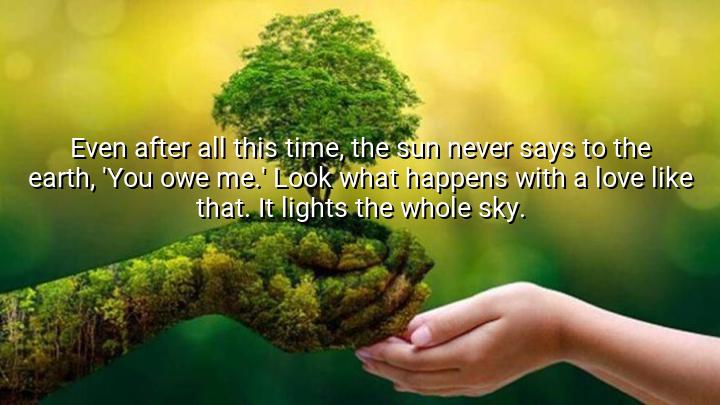




In this quote, the Persian poet Hafez illustrates the selflessness and generosity inherent in unconditional love. By using the relationship between the sun and the earth as a metaphor, Hafez emphasizes that true love doesn’t come with expectations of repayment or recognition. The sun, despite constantly giving its light and energy to the earth, never asks for anything in return. This act of pure giving is contrasted with the often transactional nature of human relationships, where love or kindness is sometimes contingent on receiving something back.
Hafez’s comparison serves to highlight the transformative power of selfless love. When love is given freely, without expectation, it has the ability to illuminate and uplift everything it touches. Just as the sun’s rays light up the sky, a love that is pure and unconditional can have a profound effect on those who experience it. The idea that a love like this can “light the whole sky” suggests that true love spreads positivity and joy, brightening the world around us in ways that can be both subtle and powerful.
The quote also speaks to the eternity and constancy of genuine love. The sun’s relationship with the earth is ongoing and unaffected by time—just as real love endures regardless of circumstances. This enduring nature of love is a central theme in many of Hafez's poems, where he explores the idea that love, when given freely, is both a source of strength and beauty.
Ultimately, Hafez’s quote encourages us to approach love with the same openness and generosity as the sun’s relationship with the earth. It reminds us that when love is not given with strings attached, it becomes a source of endless light and growth for both the giver and the receiver.

AAdministratorAdministrator
Welcome, honored guests. Please leave a comment, we will respond soon