

Each of us have things and thoughts and descriptions of an amazing universe in our possession that kings in the 17th Century would have gone to war to possess.
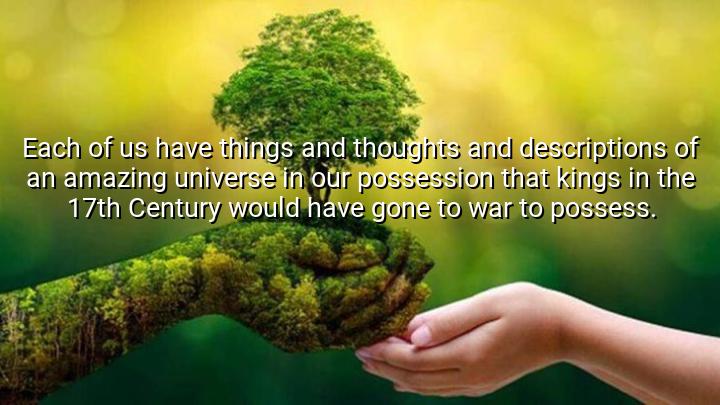




This quote by Kary Mullis, an American biochemist and Nobel laureate, reflects on the profound advancements in knowledge and technology that have made the amazing universe accessible to everyday people. When Mullis says, “Each of us have things and thoughts and descriptions,” he is referring to the knowledge and understanding that individuals can now access, such as scientific discoveries, historical records, and ideas that were once the domain of royalty or the intellectual elite.
Mullis goes on to point out that these things would have been so valuable in the past that kings in the 17th Century would have gone to war to possess them. In the past, access to knowledge—whether about the world, the stars, or the human body—was a luxury controlled by the wealthy and powerful. In contrast, today, much of this knowledge is available to the general public, largely thanks to the advent of printing presses, libraries, the internet, and modern scientific advancements.
The origin of this quote likely comes from Mullis’s reflections on the rapid progress in science and technology during his career. As a key figure in the development of polymerase chain reaction (PCR), a groundbreaking technique that revolutionized genetics, he had a firsthand view of how scientific knowledge had become more accessible and democratized. This insight is a reminder of how far humanity has come in terms of access to information, compared to earlier historical periods when royalty controlled much of the knowledge.
Ultimately, Mullis’s quote highlights the extraordinary privilege of living in a time when information and knowledge are so easily accessible. It serves as a reminder to appreciate the incredible advances in science and the technological tools that allow us to explore and understand the universe in ways that were once unimaginable—tools that, in the past, would have been coveted by even the most powerful monarchs.

KUNgo Thi Kim Uyen
This quote almost feels like a challenge—are we appreciating and utilizing the knowledge and beauty available to us in this modern world? It makes me wonder, are we empowering ourselves and others with this treasure trove of information, or are we letting its potential sit unused in digital vaults?
ANW A A N
The contrast between now and the 17th century is staggering when you think about it. We hold encyclopedias, maps, and even virtual simulations of the cosmos in our pockets. Do you think future generations will look back at us and say we squandered an opportunity to evolve our consciousness using these tools?
DHDuong Huy
It’s fascinating how this quote captures the immense value of human thought and discovery. But I’m curious—does the ease of access to such 'amazing' information reduce its perceived worth? When everything is at our fingertips, does it lose the wonder it once held for kings and scholars alike?
KCKim Chi
What a powerful perspective! I wonder if we truly understand the weight of what we hold in our hands today. Do you think people would value their digital knowledge more if they compared it to the treasures of past centuries? Maybe we need to be reminded more often of how revolutionary our current era really is.
PLPham Tran Phuong Linh
This quote really makes me reflect on how much we take for granted. With smartphones and the internet, we have access to more knowledge than entire empires once did. Do you think we’re using this access to its fullest potential, or are we letting this 'amazing universe' slip through our fingers with distractions and superficiality?