

Doubt is not below knowledge, but above it.
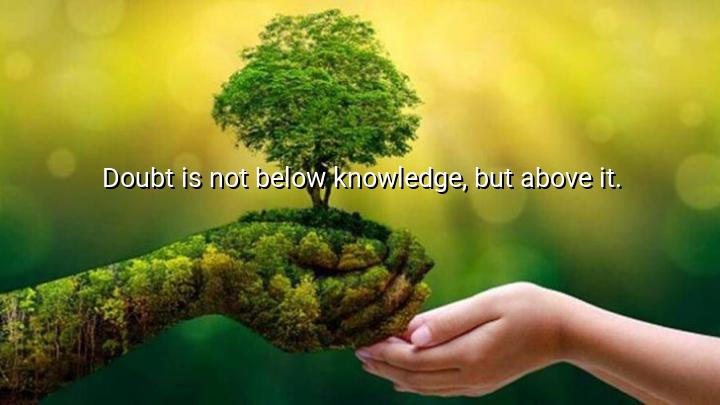




The quote, "Doubt is not below knowledge, but above it," by Alain René Le Sage, emphasizes the crucial role of doubt in the pursuit of understanding. Rather than viewing doubt as a weakness or a lack of knowledge, Le Sage elevates it as a higher form of intellectual engagement. Doubt drives inquiry, questioning, and critical thinking, enabling individuals to test the validity of information and explore deeper truths beyond surface-level knowledge.
Alain René Le Sage (1668–1747) was a French novelist and playwright, best known for his novel Gil Blas. While primarily recognized for his literary works, Le Sage also engaged with philosophical ideas, particularly those concerning human reason, skepticism, and the limits of knowledge. This quote reflects the Enlightenment-era fascination with rational inquiry and the belief that reasoned doubt is essential to genuine understanding.
The statement challenges the assumption that accumulating knowledge alone is sufficient for wisdom. Le Sage suggests that doubt functions as a tool to refine and improve knowledge, acting as a lens through which truth can be discerned more accurately. In this sense, doubt is elevated above mere information, because it allows one to question assumptions, avoid dogma, and approach reality with intellectual humility.
Ultimately, the quote encourages a balance between knowledge and critical reflection. It teaches that true wisdom does not consist only of what we know, but also of our willingness to question, challenge, and reassess that knowledge. By placing doubt “above” knowledge, Le Sage underscores its vital role in fostering insight, intellectual growth, and a more nuanced understanding of the world.

AAdministratorAdministrator
Welcome, honored guests. Please leave a comment, we will respond soon