

Do you really think it is weakness that yields to temptation? I tell you that there are terrible temptations which it requires strength, strength and courage to yield to.
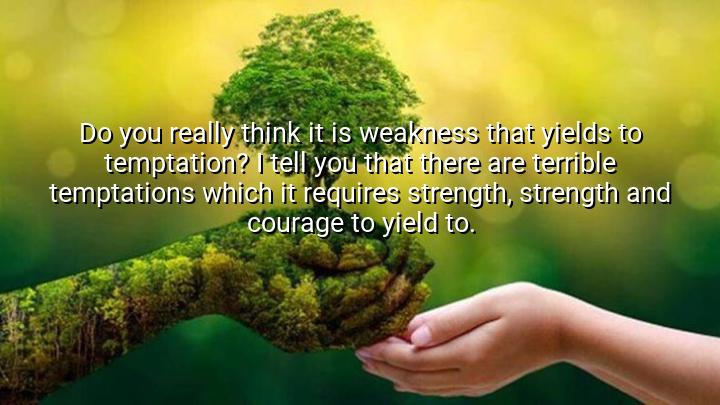




The quote "Do you really think it is weakness that yields to temptation? I tell you that there are terrible temptations which it requires strength, strength and courage to yield to" by Oscar Wilde challenges the common belief that giving in to temptation is a sign of weakness. Wilde suggests that certain temptations are so powerful and overwhelming that it actually takes significant strength and courage to surrender to them. This view contradicts the typical moral perspective, which sees yielding to temptation as a failure of willpower or a sign of moral weakness.
Oscar Wilde, known for his wit, sharp observations, and critiques of societal norms, often explored themes of morality, human desires, and the complexities of personal freedom. This quote reflects his nuanced understanding of human nature, where he emphasizes the inner strength required to navigate the temptations and struggles that people face. Wilde acknowledges that some temptations, despite their negative consequences, can be so powerful that resisting them may require even more fortitude than yielding to them.
By focusing on strength and courage, Wilde points out that the decision to yield to temptation is not always an easy one and can involve an intense internal struggle. It suggests that sometimes, the act of yielding may be a deliberate choice or an inevitable outcome of human desires, which demands courage to face its repercussions, rather than merely a lapse in willpower. Wilde, in his characteristic style, asks us to reconsider how we view the relationship between weakness, strength, and temptation.
Ultimately, this quote serves as a reminder that human desires and actions are not always as simple as right or wrong. Wilde’s view complicates the moral framework around temptation, urging us to think more deeply about the strength it takes to face certain challenges, and how sometimes, yielding may require as much courage as resisting.

AAdministratorAdministrator
Welcome, honored guests. Please leave a comment, we will respond soon