

Despite what Washington thinks or does on this 15th anniversary, we the people will never forget those who perished and the lessons learned on Sept. 11, 2001.
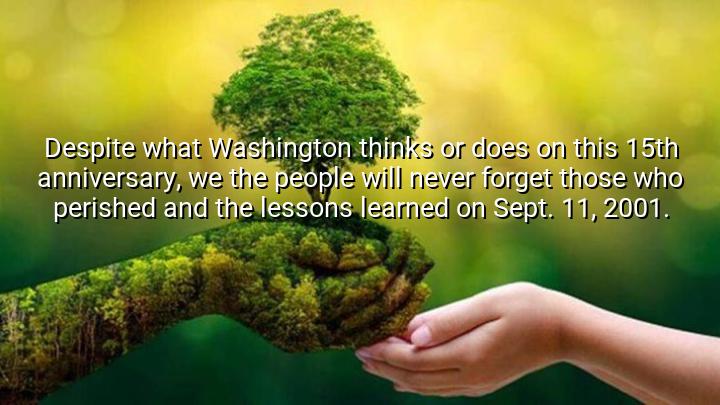




Chuck Norris’ quote reflects a strong sense of patriotism and remembrance regarding the 15th anniversary of the tragic events of September 11, 2001. He emphasizes that, regardless of the actions or decisions made by Washington (i.e., the U.S. government), the American public will never forget those who perished in the attacks. The statement underscores the resilience of the people and their commitment to remembering the victims and the lessons learned from the attacks, no matter how time passes.
By specifically referring to “we the people”, Norris invokes the foundational democratic principle that the strength and memory of the nation lie with its citizens, not just with the government or political leadership. This highlights the idea that the collective memory of the 9/11 attacks remains deeply embedded in the American public’s consciousness, regardless of political changes or government priorities.
Norris also alludes to the lessons learned from 9/11, which likely include the importance of national security, the value of unity, and the need for resilience in the face of tragedy. His words suggest that while the impact of 9/11 may have faded in some governmental discussions, the moral and emotional lessons from that day are something that the American people continue to carry with them.
Ultimately, the quote serves as a reminder of the lasting impact of 9/11 on the American identity and the collective memory of the nation. Chuck Norris stresses that while political leaders may move on or shift focus, the emotional and cultural memory of the day will remain, and the lessons of that tragedy will continue to resonate with the public.

NQNhu Quynh
Chuck Norris’s words highlight the enduring impact of 9/11 on American identity. How do collective memories of tragedy shape national values and policies over time? Is there a risk that over time, official commemorations become ritualistic rather than meaningful? Understanding how both the government and the people engage with this history could reveal much about societal cohesion.
TT30- Nguyen Thi Thuy Tien
The quote hints at skepticism toward Washington’s role in the post-9/11 era. What are some examples of government actions that might have disappointed or conflicted with public expectations? How does this affect trust in institutions responsible for national security? It would be interesting to discuss how remembrance shapes or challenges perceptions of government legitimacy.
BNBich Ngoc
This statement makes me wonder how anniversaries like the 15th impact national unity and healing. Does the public's commitment to remember override potential government missteps, or do they coexist with frustration? How do people personally interpret the lessons learned from 9/11, and do these interpretations vary widely? Exploring the gap between official narratives and personal memory could be insightful.
Uuyu
I find it compelling that Norris emphasizes the people's role in remembrance, perhaps as a form of accountability. How does public memory of 9/11 influence ongoing political decisions related to security and foreign policy? Can collective remembrance serve as a check on government actions, or does it risk becoming politicized? This quote opens a conversation about the power dynamics of memory.
BLLe ba lam
This quote suggests a tension between government actions and public memory. What specific policies or behaviors by Washington does Chuck Norris imply might not fully honor the victims of 9/11? How important is it for governments to align their commemorations with public sentiment? It raises the question of how national memory is shaped differently by officials versus the general populace.